
Portable water purifiers range from sub-$20 filter straws to electric systems costing well over $100, and the right choice depends less on price and more on how you plan to drink. For most buyers, the Sawyer Products SP128 Mini is the best overall pick — it filters up to 100,000 gallons, screws onto standard bottles, and costs less than a restaurant lunch. Budget-conscious buyers should look at the Membrane Solutions S1 straw, while groups and base-camp campers get better value from the LifeStraw Peak Compact Gravity, which filters water for several people without any pumping or sucking. The main tradeoffs in this category are speed versus weight, filter lifespan versus upfront cost, and whether you need true purification for viruses or just filtration for bacteria and protozoa. Keep reading for the full breakdown of all 12 options.

Get health and wellness essentials delivered free with Prime
- Fast, free delivery on millions of items
- Prime Video, Amazon Music and more included
- Member-only deals all year
Key Takeaways
- Filter straws dominated the value end of this comparison — the Sawyer Mini, Membrane Solutions S1, and classic LifeStraw all deliver safe drinking water under $25, but differ sharply in lifespan (100,000 gallons for the Sawyer versus roughly 264 for the cheapest straws).
- Gravity systems like the LifeStraw Peak Compact and Waterdrop straw emerged as the smart middle ground for anyone filtering water for more than one person, eliminating the fatigue of sucking or pumping that plague straw-only designs.
- Electric purifiers (the 3-in-1 and ITEHIL solar models) are the only picks here suited to consistent group use and murky source water, but their reliance on batteries or sunlight makes them a poor sole option for ultralight hikers.
- Filter bottles (SurviMate and LifeStraw Go) trade capacity for convenience — ideal for daily carry and travel, but the smallest carry capacity in the lineup and slower to refill for cooking or groups.
- Micron ratings alone proved misleading across this lineup: a 0.01μm hollow-fiber filter outperforms a 0.1μm one only against certain pathogens, and none of these filters remove viruses — buyers facing virus-risk water sources need purification tablets or boiling as backup.
| Sawyer Products SP128 Mini Water Filtration System | 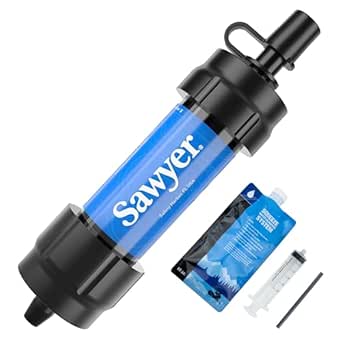 | Best Overall | Filter Micron Rating: 0.1 micron | Weight: 2 ounces | Filter Capacity: Up to 100,000 gallons | VIEW LATEST PRICE | See Our Full Breakdown |
| Membrane Solutions Personal Water Filter Straw S1 |  | Best Value Pick | Certification: NSF/ANSI 42, 372, 401 | Filtration Capacity: 1,320 gallons (5,000 liters) | Filtration Stages: 5 | VIEW LATEST PRICE | See Our Full Breakdown |
| LifeStraw Peak Compact Gravity Water Filter, 3 L, Mountain Blue |  | Best for Group Camping | Capacity: 3 liters | Filter Type: Gravity water filter | Bacteria Removal: 99.999999% | VIEW LATEST PRICE | See Our Full Breakdown |
| 3-in-1 Portable Electric Water Filter for Survival Kit & Emergency |  | Best for Emergency Kits | Flow Rate: 800ml per minute | Power Sources: USB-C, solar panel, hand-crank | Filter Capacity: 5,000 liters | VIEW LATEST PRICE | See Our Full Breakdown |
| ITEHIL Portable Electric Water Filter with Solar Power and Dual Filtration System | 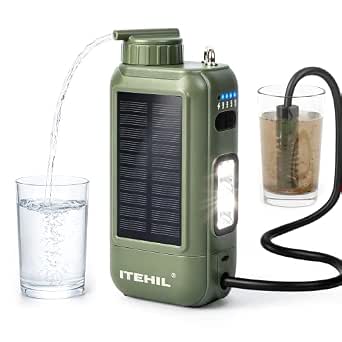 | Best Premium Filtration | Filtration Precision: 0.01 microns | Contaminant Removal: 99.99% including heavy metals, bacteria, viruses | Flow Rate: 700ml per minute | VIEW LATEST PRICE | See Our Full Breakdown |
| LifeStraw Personal Water Filter for Hiking, Travel and Emergency, Blue, 1 Pack |  | Best Budget Straw for Solo Travelers | Removes: Bacteria, parasites, microplastics | Filtration Capacity: 4,000 liters (1,000 gallons) | Material: BPA-free | VIEW LATEST PRICE | See Our Full Breakdown |
| Waterdrop Gravity Water Filter Straw, Camping Water Filter, 0.1 Micron | 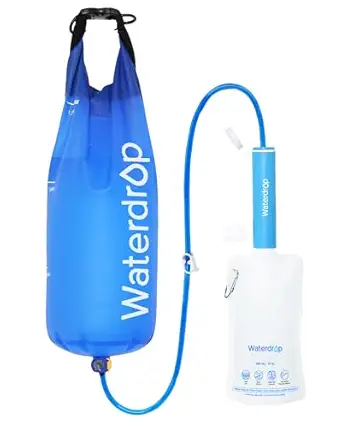 | Best Modular Straw for Camp Use | Filtration Stage: 5-stage | Micron Size: 0.1 micron | Lifespan: Up to 1,400 gallons | VIEW LATEST PRICE | See Our Full Breakdown |
| Uzima UZ-2 Camping Water Filter and Drinking Water Filter System |  | Best for Group Camping | Type: Gravity water filter system | Filtration Efficiency: Removes 99.999% of bacteria | Power Source: Manual, no electricity needed | VIEW LATEST PRICE | See Our Full Breakdown |
| SurviMate 5-Stage 0.01μm Ultra-Filtration Filtered Water Bottle BPA-Free |  | Best Filtration-to-Price Ratio in a Bottle | Filtration Stages: 5 | Pore Size: 0.01μm | Filter Lifespan: 1,500 liters (396 gallons) | VIEW LATEST PRICE | See Our Full Breakdown |
| LifeStraw Go Series Stainless Steel Water Filter Bottle, 18 oz, Aegean Sea |  | Best Premium Filtered Bottle | Capacity: 18 oz | Material: Stainless steel, BPA-free | Insulation: Double-wall vacuum | VIEW LATEST PRICE | See Our Full Breakdown |
| Pro Portable Water Filter for Camping – Water Purifier Survival |  | Best for Group Camping | Filtration Method: 3-stage PP cotton and ultrafiltration | Filtration Accuracy: 5µm + 0.01µm | Flow Rate: 1.5 liters per minute | VIEW LATEST PRICE | See Our Full Breakdown |
| Collapsible Water Filter Bottle with NSF/FDA Certification – BPA-Free, 5000L Capacity |  | Best Packable Bottle | Filtration Accuracy: 0.01µm | Filtration Stages: 3-layer filtration system | Filter Capacity: 5000 liters | VIEW LATEST PRICE | See Our Full Breakdown |
More Details on Our Top Picks
Sawyer Products SP128 Mini Water Filtration System
The Sawyer Mini earns the top spot because it solves the problem every portable purifier buyer cares about most: longevity. With a rated capacity of up to 100,000 gallons, this filter can outlast dozens of cheaper alternatives — the Membrane Solutions S1 straw, by comparison, is rated for just 1,320 gallons. That gap matters if you want one purchase to cover years of day hikes, international travel, and an emergency kit. At 2 ounces, it is no heavier than a straw filter, but the squeeze-pouch design is faster for filling bottles than drinking straight from a source. The tradeoff is real, though: flow slows noticeably in silty or cold water, and you must backflush regularly to keep it working. Compared with gravity systems like the LifeStraw Peak Compact, it demands more effort per liter.
Pros:- Enormous 100,000-gallon filter life dwarfs nearly every competitor
- Just 2 ounces, lighter than most straw and gravity options
- Removes bacteria, protozoa, and microplastics at 0.1 microns
- Flexible attachment works with pouches, bottles, or the included straw
Cons:- Flow rate drops badly in cold or sediment-heavy water without frequent backflushing
- Manual squeeze operation is slower and more effortful than electric or gravity systems
Best for: Backpackers and preparedness-minded buyers who want a filter that lasts essentially a lifetime of occasional use
Not ideal for: People who want hands-free, high-volume filtering for a group — squeezing a pouch repeatedly gets tedious fast
- Filter Micron Rating:0.1 micron
- Weight:2 ounces
- Filter Capacity:Up to 100,000 gallons
- Included Accessories:16-oz reusable squeeze pouch, 7-inch drinking straw, cleaning plunger
- Removes:Bacteria, protozoa, microplastics
- Type:Squeeze/inline filter
Our verdict“If you only buy one filter, buy this one — nothing else matches its lifespan per dollar.”
Membrane Solutions Personal Water Filter Straw S1
For buyers on a tight budget, the Membrane Solutions S1 delivers certified filtration performance at a price well below the Sawyer Mini. Its NSF/ANSI certifications (42, 372, and 401) cover taste, lead-free materials, and emerging contaminants — credentials many straw filters in this roundup can’t claim. The 1,320-gallon capacity is respectable for the category, though it’s a fraction of the Sawyer’s lifespan, which is the core reason this is the value pick rather than the overall winner. The 5-stage filtration also targets microplastics that simpler one-stage straws miss. Be aware of what it can’t do: it does not reduce TDS or dissolved minerals, so brackish or chemically contaminated water remains off-limits. Compared with the LifeStraw Personal, it’s similarly priced but offers longer rated life and container compatibility.
Pros:- NSF/ANSI certified for safety, taste, and contaminants at a budget price
- 1,320-gallon capacity outlasts most similarly priced straws
- 5-stage filtration captures microplastics and bacteria
- Works as a straw or attaches to standard water containers
Cons:- Does not reduce TDS, dissolved minerals, or salt
- Requires periodic backflushing and eventual replacement to maintain flow
Best for: Budget-conscious hikers and travelers who want certified filtration without paying premium prices
Not ideal for: Anyone filtering silty water long-term — backflushing maintenance is required and flow varies with source quality
- Certification:NSF/ANSI 42, 372, 401
- Filtration Capacity:1,320 gallons (5,000 liters)
- Filtration Stages:5
- Pore Size:0.1 micron
- Flow Rate:16.9 fl oz/min
- Weight:2 ounces
- Material:BPA-free ABS plastic
Our verdict“The smartest cheap insurance policy for day hikers — just don’t expect Sawyer-level longevity.”
LifeStraw Peak Compact Gravity Water Filter, 3 L, Mountain Blue
When you’re filtering water for two or more people, squeezing a pouch gets old fast — that’s where the LifeStraw Peak Compact changes the equation. Its gravity-fed 3-liter system does the work while you set up camp, something no straw or squeeze filter in this lineup can match. It posts some of the strongest protection numbers here: 99.999999% of bacteria and 99.999% of parasites, plus microplastics and sediment. The versatility is genuinely useful — it converts to a squeeze bottle or straw, so it partially replaces the Sawyer Mini for solo trips. The compromises are patience and volume: each cycle handles only 3 liters, and filtering takes time, making it a poor match for on-the-move hydration. Compared with electric options like the ITEHIL, it needs no battery, which is its own kind of reliability.
Pros:- Hands-free gravity filtration fills bottles and reservoirs without effort
- Industry-leading 99.999999% bacteria and 99.999% parasite removal
- Four use modes: gravity bag, squeeze bottle, straw, or inline with bottles
- Durable, leak-proof build suited to rough camp use
Cons:- Requires setup time and patience — not for rapid, on-demand drinking
- 3-liter batch capacity limits throughput for larger groups at once
Best for: Base campers and families who need hands-free, battery-free filtration of larger volumes
Not ideal for: Through-hikers or runners who need to drink immediately at a source — gravity takes minutes, not seconds
- Capacity:3 liters
- Filter Type:Gravity water filter
- Bacteria Removal:99.999999%
- Parasite Removal:99.999%
- Also Removes:Microplastics, silt, sand
- Use Modes:Gravity, squeeze, straw, bottle attachment
- Color:Mountain Blue
Our verdict“The right pick when feeding several people at camp matters more than drinking on the move.”
3-in-1 Portable Electric Water Filter for Survival Kit & Emergency
This filter’s strongest argument is power redundancy: USB-C, solar, and a hand-crank mean it works even when every battery in your go-bag is dead — a scenario the ITEHIL, with its fixed 5200mAh cell, handles less gracefully. An 800ml-per-minute flow rate beats any manual option here, including the Sawyer Mini, which matters when you’re filling containers for a household. The built-in LED light rounds out its emergency-kit credentials. The honest tradeoffs: hand-cranking is tiring for large volumes, the 5,000-liter filter life is far shorter than the Sawyer’s, and the manufacturer provides little verified data on heavy-metal removal, so I’d treat this as a bacteria-and-sediment tool, not a chemical-purification device. At 360 grams, it’s also several times heavier than any straw filter in this guide.
Pros:- Three independent power sources including off-grid hand-crank and solar
- 800ml/min electric flow outpaces all manual filters in this roundup
- 8-layer filtration handles sediment, bacteria, and taste in one pass
- Built-in LED light adds nighttime utility to an emergency kit
Cons:- Hand-crank operation is physically tiring for large volumes
- Limited published data on heavy-metal and virus filtration effectiveness
Best for: Emergency preppers who want fail-safe, multi-power filtration capable of quickly supplying a household
Not ideal for: Ultralight backpackers — at 360 grams and needing charging management, it’s overkill for solo trail use
- Flow Rate:800ml per minute
- Power Sources:USB-C, solar panel, hand-crank
- Filter Capacity:5,000 liters
- Filtration Layers:8 (PP cotton, activated carbon, ultrafiltration membranes)
- Weight:360 grams
- Extras:Built-in LED light
Our verdict“A go-bag essential for households that need fast water when the grid is down — skip it for weight-conscious trail use.”
ITEHIL Portable Electric Water Filter with Solar Power and Dual Filtration System
The ITEHIL sits at the premium end because it filters what cheaper options can’t: with 0.01-micron dual filtration, it claims removal of 99.99% of viruses and heavy metals — threats the Sawyer Mini and Membrane Solutions S1 are not designed to address. For travel in regions with questionable municipal water, that difference is the whole point. The 5200mAh battery doubles as an emergency power bank, and Type-C plus solar charging keeps it running off-grid, making it more travel-friendly than the hand-crank-reliant 3-in-1 emergency filter. But premium performance carries real costs: the filter cartridge needs replacement every six months, total filter life is only 1,000 liters — a tenth of the 3-in-1’s rated capacity — and solar charging depends entirely on weather. The flow rate of 700ml/min is slightly slower than the 3-in-1’s as well.
Pros:- 0.01-micron dual filtration targets viruses and heavy metals most rivals can’t touch
- 5200mAh battery doubles as an emergency power bank with light
- Type-C and solar charging offer flexible off-grid recharging
- Push-button 700ml/min flow requires zero physical effort
Cons:- Filter cartridge replacement every six months adds ongoing cost and hassle
- Only 1,000-liter filter life is short for the price point
Best for: International travelers and overlanders who need virus and heavy-metal protection, not just bacteria filtration
Not ideal for: Casual backpackers filtering clear mountain water — the virus-rated filtration and cartridge costs are wasted money
- Filtration Precision:0.01 microns
- Contaminant Removal:99.99% including heavy metals, bacteria, viruses
- Flow Rate:700ml per minute
- Filter Lifespan:Up to 1,000 liters
- Battery:5200mAh (also functions as power bank)
- Charging:Type-C and solar
- Cartridge Replacement:Every 6 months
Our verdict“Worth the premium only if your water sources carry viral or chemical risks beyond what standard filters handle.”
LifeStraw Personal Water Filter for Hiking, Travel and Emergency, Blue, 1 Pack
For pure simplicity at a rock-bottom price, this is the straw that defined the category. The 4,000-liter filtration capacity is remarkable at this cost — double what the SurviMate filtered bottle offers — and it strips out bacteria, parasites, and microplastics without any setup. Where the Waterdrop gravity straw adds a 5-stage system and backwash function, LifeStraw bets on doing fewer things with proven reliability, which is exactly what most solo hikers need. The tradeoff is effort and patience: you drink straight from the source, so there’s no storage, no gravity assist, and no way to serve a group. It also won’t touch viruses or improve taste the way carbon-equipped rivals do. Still, as a set-it-and-forget-it emergency backup that lives in a pack for years, nothing else here matches its value per liter.
Pros:- Exceptional 4,000-liter capacity for the price
- Removes bacteria, parasites, and microplastics
- No setup, pumping, or batteries required
- Featherweight and small enough for any pack or emergency kit
Cons:- Drinking requires noticeable suction effort, tiring over a long day
- No built-in storage, pump, or group-serving capability
- Does not remove viruses or chemical contaminants
Best for: Solo hikers, backpackers, and preppers who want a lightweight, low-cost personal backup filter
Not ideal for: Groups or families — one straw serves one person, and there’s no way to fill bottles for others
- Removes:Bacteria, parasites, microplastics
- Filtration Capacity:4,000 liters (1,000 gallons)
- Material:BPA-free
- Color:Blue
- Pack Size:1 pack
- Type:Personal filter straw
Our verdict“Buy this if you want the cheapest, most trusted way for one person to drink safely from a stream — skip it if you’re filtering for more than yourself.”
Waterdrop Gravity Water Filter Straw, Camping Water Filter, 0.1 Micron
This option stands out for bridging the gap between a simple straw and a full gravity system. The 0.1-micron 5-stage membrane means it handles chlorine, sediment, and odors — categories the basic LifeStraw Personal Filter ignores — and the included water bag plus backwash function let you actually maintain flow rate over time instead of watching performance decay. Paired with bottles or bags, it becomes a small camp station rather than a single-user tool, which is why it sits above bare straws in this lineup for anyone cooking or sharing. The compromises are real: backwashing is a manual chore you’ll forget at your peril, and against the Uzima UZ-2’s purpose-built gravity rig, it’s bulkier than a straw should be. Compared with similar straw-only options, though, the added chemistry and versatility justify the size.
Pros:- 5-stage filtration removes chlorine, sediment, and odors, not just pathogens
- Up to 1,400-gallon lifespan
- Backwash function extends usable life and restores flow
- Works with water bags and standard bottles for flexible use
Cons:- Requires regular manual backwashing to keep flow rate acceptable
- Struggles with heavily contaminated or turbid water sources
- Bulkier than dedicated straw filters for compact packing
Best for: Car campers and small groups who want one filter that works as both a straw and a gravity-fed station
Not ideal for: Ultra-light thru-hikers — the bag and housing add bulk a minimalist straw doesn’t
- Filtration Stage:5-stage
- Micron Size:0.1 micron
- Lifespan:Up to 1,400 gallons
- Water Bag Capacity:1.5 gallons
- Flow Rate:Up to 700 ml/min
- Backwash Function:Yes
- Compatible With:Water bags, bottles
Our verdict“This pick makes the most sense for campers who want straw portability with gravity-bag flexibility — pure minimalists should stick with a lighter straw.”
Uzima UZ-2 Camping Water Filter and Drinking Water Filter System
When the job is feeding several people at basecamp rather than one hiker on the trail, this gravity-fed system earns its place. Unlike the Waterdrop straw, which needs manual backwashing and drinking effort, the UZ-2 does the work passively: fill it, hang it, and let gravity fill bottles while you set up tents. Its 99.999% bacterial removal and global certifications make it a credible choice for international trips where water sources are questionable, and compatibility with purification tablets adds a virus-coverage option that none of the straw products in this roundup can claim alone. The flip side is that capacity per use is limited, so a thirsty group waits on refills, and it’s simply too bulky to carry for solo day hikes. Think of it as camp infrastructure, not personal gear.
Pros:- Gravity-fed operation fills bottles with no pumping or suction effort
- Removes 99.999% of bacteria with global certifications
- Works with purification tablets for added virus protection
- Simple assembly with no power source needed
Cons:- Limited filtration capacity per cycle means frequent refills for groups
- Bulkier and heavier than straw-style filters
- Manual setup and hanging required at each water source
Best for: Families and small groups at basecamp who need hands-free, electricity-free water for multiple people
Not ideal for: Solo hikers or anyone counting grams — it’s a basecamp system, not a pack-and-go filter
- Type:Gravity water filter system
- Filtration Efficiency:Removes 99.999% of bacteria
- Power Source:Manual, no electricity needed
- Certifications:Globally certified
- Tablet Compatibility:Yes, works with purification tablets
- Use Cases:Camping, hiking, hunting, emergency preparedness
Our verdict“Choose this over any straw if you’re filtering for a group at camp — pass on it if you’re moving light and alone.”
SurviMate 5-Stage 0.01μm Ultra-Filtration Filtered Water Bottle BPA-Free
This model is better suited to buyers who want filtration depth without paying for premium bottle construction. Its 0.01-micron pore size is ten times finer than the Waterdrop’s 0.1 micron, and the 5-stage system tackles heavy metals and chlorine — contaminants most straw filters in this roundup, including the classic LifeStraw Personal, simply pass through. The built-in compass is a small but genuine plus for survival-minded users. Compared with the LifeStraw Go stainless bottle, you sacrifice insulation and polish but gain finer filtration and a lower price. Be prepared for quirks: first draws can run black with carbon fines until the filter rinses in, and the higher suction resistance makes casual sipping harder than a normal bottle. It also demands hand washing. For the filtration performance per dollar, though, few bottled options compete.
Pros:- 0.01μm pore size catches heavy metals and chlorine most straws miss
- 5-stage filtration with 1,500-liter filter life
- Built-in compass for outdoor navigation
- BPA-free Tritan body at a budget-friendly price
Cons:- Initial draws can contain black carbon particles until flushed
- Noticeably more suction required than a standard bottle
- Not dishwasher safe
Best for: Budget-conscious campers and survival-kit builders who prioritize fine filtration over bottle refinement
Not ideal for: Daily commuters or gym users — the suction effort and carbon-break-in period make it awkward as an everyday bottle
- Filtration Stages:5
- Pore Size:0.01μm
- Filter Lifespan:1,500 liters (396 gallons)
- Maximum Flow Rate:550 ml/min
- Material:BPA-free Tritan
- Weight:10.08 ounces
- Dimensions:9.4″L x 3.1″W x 9.4″H
- Temperature Range:32°F to 90°F
Our verdict“If you want the finest filtration you can buy in a bottle without premium pricing, this is it — just flush the filter first and expect a workout when you sip.”
LifeStraw Go Series Stainless Steel Water Filter Bottle, 18 oz, Aegean Sea
This is the pick when the bottle matters as much as the filter. The double-wall vacuum-insulated stainless body keeps water cold all day — something neither the SurviMate Tritan bottle nor any straw in this roundup can do — while the integrated microfilter and carbon stage handle bacteria, parasites, microplastics, and taste. That carbon filter is what elevates it for travelers faced with chlorinated tap water abroad, though it demands attention: the carbon stage lasts only about 26 gallons, roughly two months of regular use, while the hollow-fiber membrane stretches to 1,000 gallons. At 18 oz, capacity is modest for a full day out, so heavy sweaters will refill often. What you’re paying for is durability and polish — if you’d rather have finer pore ratings than insulation, the SurviMate does more filtering for less money.
Pros:- Filters bacteria, parasites, microplastics, and odors for genuinely better taste
- Double-wall insulation keeps water cold all day
- Durable stainless steel construction travels well
- Microfilter membrane rated for up to 1,000 gallons
Cons:- Carbon filter lasts only ~26 gallons (about two months) and needs scheduled replacement
- 18 oz capacity means frequent refills on long days
- Premium price compared with straw-only alternatives
Best for: Travelers and day-hikers who want cold, better-tasting filtered water in a bottle that lasts years
Not ideal for: High-volume hydration needs or forgetful owners — 18 oz fills fast and the carbon filter dies quickly if replacements are skipped
- Capacity:18 oz
- Material:Stainless steel, BPA-free
- Insulation:Double-wall vacuum
- Microfilter Lifespan:Up to 1,000 gallons
- Carbon Filter Lifespan:26 gallons (~2 months)
- Removes:Bacteria, parasites, microplastics, odors
- Color:Aegean Sea
Our verdict“Worth it for travelers who value insulation and taste in one durable package — budget buyers who only need pathogen removal should grab a basic straw instead.”
Pro Portable Water Filter for Camping – Water Purifier Survival
When a whole camp needs water, most personal filters fall short — and that’s exactly the gap this pump fills. At 1.5 liters per minute, it produces enough flow to hydrate four to six people, where a LifeStraw Personal Filter or a Membrane Solutions straw would have everyone waiting in line for a slow, single-user sip. The 3-stage ultrafiltration (5µm pre-filter plus 0.01µm membrane) removes bacteria, protozoa, cysts, and microplastics, which puts it ahead of simpler squeeze systems when the source water is cloudy or silty. Compared with the 3-in-1 Portable Electric Water Filter, this one trades battery dependence for a hand pump — nothing to charge, but more physical work on long trips.
The tradeoff is weight. At 4 pounds, this is basecamp gear, not backpacking gear.
Pros:- 1.5 L/min flow rate easily serves a group of 4-6 people
- 3-stage ultrafiltration handles cloudy, sediment-heavy sources that clog simpler filters
- Complete kit with reusable pre-filter, tubes, clamps, and carry bag
- 3000-liter filter life covers multiple seasons of group trips
Cons:- At 4 pounds, it’s too heavy for backpacking or solo travel
- Manual pumping becomes tiring when filling multiple large containers
- Only rated for water with TDS under 100 PPM, so it can’t handle brackish or heavily mineralized sources
Best for: Car-camping families and basecamp groups of 4-6 who need to produce large volumes of safe water quickly from lakes or streams
Not ideal for: Ultralight backpackers and solo thru-hikers — at 4 pounds it weighs more than most entire cook kits, and a straw or squeeze filter does the same job lighter
- Filtration Method:3-stage PP cotton and ultrafiltration
- Filtration Accuracy:5µm + 0.01µm
- Flow Rate:1.5 liters per minute
- Filter Capacity:3000 liters
- Weight:4 pounds
- Dimensions:10″L x 3.5″W x 13.5″H
- Power Source:Hand operated
Our verdict“Buy this if you’re filtering water for a camp of several people; skip it if you’re moving on foot and counting ounces.”
Collapsible Water Filter Bottle with NSF/FDA Certification – BPA-Free, 5000L Capacity
This is the roundup’s space-saver pick. Unlike the rigid SurviMate 5-Stage Filtered Bottle or the LifeStraw Go Stainless Steel, this TPU bottle collapses flat when empty, freeing precious pack space between water sources — a real advantage for travelers and fastpackers who carry their filtration only part of the day. The 0.01µm three-layer filter claims 99.9999% removal of bacteria, odors, and sediment, and the NSF/FDA certification gives it a documented safety pedigree many budget collapsible bottles lack. Its 5000-liter filter capacity actually exceeds the Pro pump’s 3000-liter rating, so longevity per dollar is strong.
The compromises: it’s a bottle, not a group system — you fill for one. And the soft TPU body, while tough for its class, is more vulnerable to puncture around sharp gear than a hard-sided bottle.
Pros:- Collapses flat for minimal packed volume between water sources
- 5000-liter filter life outlasts many pump systems in this roundup
- NSF/FDA certification provides verified safety standards
- Food-grade BPA-free TPU is lightweight and taste-neutral
Cons:- Soft TPU body is more puncture-prone than hard-sided bottles like the LifeStraw Go
- Filter replacements required, adding long-term cost
- Single-serving format is impractical for filtering water for cooking or groups
Best for: Ultralight hikers, international travelers, and day-trippers who want a filter that disappears into a pack when empty
Not ideal for: Group expeditions or basecamp use — one bottle can’t serve multiple people, and the soft body isn’t built for rough handling around camp
- Filtration Accuracy:0.01µm
- Filtration Stages:3-layer filtration system
- Filter Capacity:5000 liters
- Material:Food-grade TPU (BPA-free)
- Capacities:650 ml, 1000 ml
- Colors:Blue, White, Gray
- Certifications:NSF/FDA
Our verdict“This pick makes the most sense for solo travelers who value packed size above all — anyone serving a group should look at a pump or gravity system instead.”
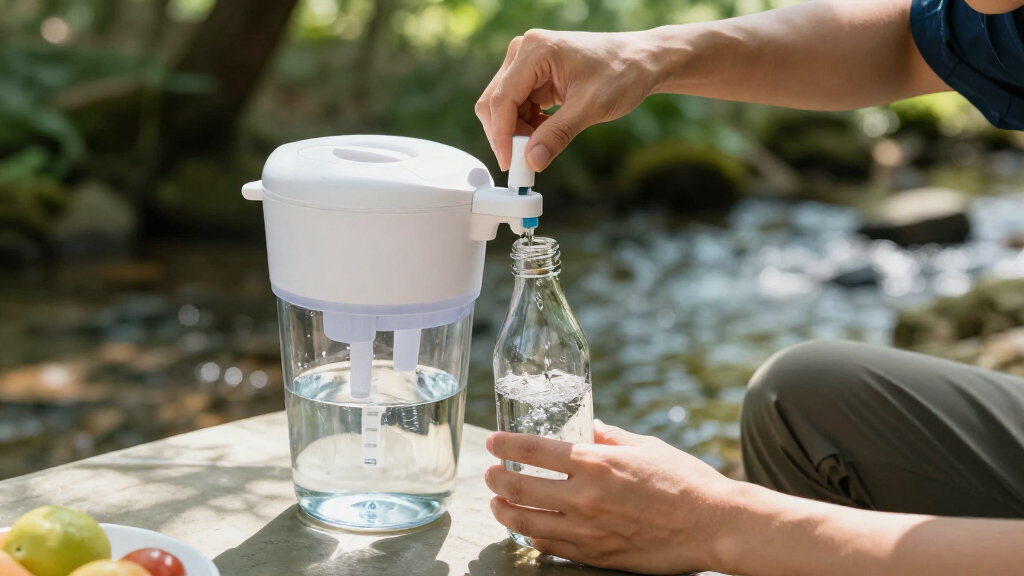
How We Picked
Ranking portable water purifiers fairly means judging them against what they’re built to do, not against each other in a single vacuum. A 2-ounce straw and a 3-liter gravity bag serve completely different buyers, so each product was evaluated on four factors: filtration performance (micron rating, what pathogens are removed, and how well flow holds up over time), practical usability (weight, setup effort, drink speed, and whether it works for one person or a group), long-term value (rated filter lifespan and replacement cost per gallon), and durability and maintenance (field-cleanability, backflush support, and what happens when the filter clogs mid-trip).
The ranking logic reflects real-world drinking scenarios rather than spec sheets. Products that solve the most common failure points — clogging, slow flow, and awkward sourcing from shallow water — ranked higher, while one-trick designs that only work with easily accessed, clear water ranked lower even when their raw filtration numbers looked good on paper. Price was weighed against lifespan rather than treated as a standalone criterion, which is why a slightly pricier filter with a 100,000-gallon rating beats a cheaper one that needs replacing after a few trips.
Factors to Consider When Choosing Portable Water Purifiers
Before locking in a purchase, it helps to understand the broader landscape of portable water purification — because the most common buying mistakes in this category come from mismatched expectations, not bad products.Filtration vs. Purification: The Distinction That Matters Most
Most products labeled “water purifiers” are technically filters — they physically strain out bacteria and protozoa but do nothing to viruses, which are small enough to pass through even 0.01μm hollow-fiber membranes. True purification requires chemicals (chlorine dioxide tablets), UV treatment, or boiling, and no filter on this list replaces those methods if you’re drawing from water sources contaminated by human waste, common in densely traveled regions or post-disaster scenarios. For North American backcountry streams, filtration alone is generally sufficient. For international travel or emergency preparedness kits, layering a filter with purification tablets is the safer approach, and the small added weight is cheap insurance. Buyers who skip this distinction are the ones who end up disappointed, because the product did exactly what it was designed to do — just not what they assumed.
Sole-User vs. Group Systems: Buy for Your Real Group Size
The single most common mistake is buying a personal straw for a family trip, or lugging a 3-liter gravity system on a solo ultralight hike. Straws and squeeze filters work hard for one person but become tedious when three people are waiting to share them, and flow rates drop further as filters load up. Gravity bags flip the equation: they’re overkill for a solo day-hiker but transformative for camp kitchens, since they filter liters hands-free while you cook. A practical rule of thumb — one straw-style filter per two people maximum, and a gravity or electric system once you hit three or more. Budget accordingly, because two well-chosen personal filters often cost less and perform better than one group system stretched past its intended use.
Filter Lifespan and Cost per Gallon
Upfront price tells you almost nothing about what a water filter actually costs. A $20 straw rated for 264 gallons costs roughly 7.5 cents per gallon; a $40 squeeze system rated for 100,000 gallons costs a small fraction of a cent per gallon, making it orders of magnitude cheaper over time despite the higher sticker price. Check whether the filter is cleanable and backflushable — a flushable filter that restores full flow extends rated lifespan dramatically, while sealed disposable cartridges hit their end-of-life whether they’re clogged or not. Also look at replacement cartridge availability before buying, since some smaller brands discontinue filters and leave the housing useless. For occasional day-hikers this math matters little; for thru-hikers, preppers, and frequent travelers it should drive the entire decision.
Source Water Quality and Clogging Risk
Crystal-clear alpine streams and silty farm-pond water demand completely different equipment. Hollow-fiber filters clog fast on turbid water, and a clogged filter in the field isn’t just slow — with straw designs, it can become unusable with no way to force water through. Prefilters, coffee filters, or simply letting water settle in a container before filtering dramatically extend filter life, but electric purifiers with intake screens and multi-stage systems handle murky sources with the least fuss. If your anticipated sources include standing water, agricultural runoff, or post-storm debris, prioritize systems with prefiltration stages or plan to carry a settling container. Clear, moving backcountry water is far more forgiving, and nearly anything in this category will handle it.
Weight, Packability, and Speed Tradeoffs
Every ounce matters on a thru-hike and almost nothing matters in a car-camping bin, so match the form factor to how you actually travel. Straws weigh an ounce or two but require you to be at the water source every time you drink; filter bottles add convenience but carry less than a liter; gravity bags pack flat and weigh little for their capacity but need time and a hanging point to work. Electric purifiers are heaviest and need charging, but deliver pressurized flow with zero effort — a real advantage for anyone with limited lung capacity, kids, or group base camps. There’s no universal winner here, only alignment: the fastest-drinking option is rarely the lightest, and the lightest is rarely the most versatile.
Certifications and Realistic Safety Claims
Look for NSF/ANSI 53 or 58 certifications, EPA registration, or independent lab results naming specific pathogens removed — not vague marketing language like “removes 99.99% of impurities,” which is meaningless without naming what’s being removed and at what rate. Be skeptical of unbranded listings that cite impressive micron ratings with no test data behind them; hollow-fiber quality varies more between factories than the specs suggest. Established brands (Sawyer, LifeStraw, and similar) publish their testing and honor warranties, which matters when a product failure means getting sick a day’s walk from help. Certifications also affect resale or donation value for emergency kits, since preparedness organizations typically only accept certified filters. A few minutes verifying claims beats weeks of gastrointestinal regret.
Frequently Asked Questions
Do any of these portable water purifiers remove viruses?
No — every filter in this roundup, including the 0.01μm ultra-filtration models, is designed to remove bacteria and protozoa, but viruses are physically small enough to slip through hollow-fiber membranes. That’s fine for most North American backcountry water, where viral contamination is rare, but it’s a genuine gap for travel in regions with poor sanitation or for post-disaster scenarios where sewage contamination is possible. The standard workaround is layering: filter the water first to remove particulates and the larger pathogens, then treat with chlorine dioxide tablets, which kill viruses in 30 minutes (four hours for cryptosporidium). Boiling is the other reliable backup and costs nothing if you have a stove. If virus protection is a primary concern, build the layered approach into your kit rather than shopping for a filter that claims to do it all.
Is a filter straw like the Sawyer Mini enough, or should I buy a gravity system?
It comes down to group size and how you drink. A squeeze or straw filter is genuinely sufficient for one to two people drinking directly from sources during the day — it’s light, fast to deploy, and inexpensive. The math changes at camp: filling pots for cooking, making coffee, and hydrating three or more people through a single straw becomes a chore, and sucking effort increases as the filter loads. Gravity systems shine precisely here because they filter liters unattended while you do other things, and they let you haul water away from the source. Many experienced backpackers actually carry both — a squeeze filter for on-trail sipping and a gravity bag for camp — since the two overlap in weight but not in function. If you can only buy one and you mostly day-hike solo, the straw wins; for family camping or base camps, go gravity.
Are electric water purifiers worth the extra cost and weight?
For the right buyer, absolutely — but that buyer is narrower than the marketing suggests. Electric purifiers earn their price when you’re filtering for groups, drawing from murky sources where manual sucking would be exhausting, or when users (kids, older adults, anyone with reduced lung strength) struggle with straw-style filters. The pressurized flow also fills bottles and pots far faster than gravity alone. The tradeoffs are real: batteries die, solar charging depends on weather, and a dead unit with no manual backup mode is dead weight. That’s why electric models make the most sense as a base-camp primary paired with a cheap straw as backup, rather than as your only water solution. Ultralight hikers and solo travelers will almost always be better served spending less on a mechanical filter.
How do I keep a portable water filter from clogging mid-trip?
Clogging is the number one field failure, and it’s almost always preventable with technique. Start by prefiltering turbid water — either through a cloth or coffee filter, or by letting a container of water settle for 15–20 minutes and drawing from the top. Backflush or swab your filter regularly (Sawyer includes a syringe for exactly this; LifeStraw’s Peak series is designed to be cleaned in the field), because flushing restores flow before the clog becomes permanent. Never let a hollow-fiber filter freeze, since ice crystals crack the fibers invisibly — a frozen filter can pass contaminated water while looking perfectly fine, so sleep with it in your bag in cold weather. Finally, dry the filter fully before long-term storage between trips. Filters treated this way routinely outlast their rated lifespans.
Are cheap filter straws under $20 actually safe to trust?
The established budget brands — the classic LifeStraw, Membrane Solutions, and Waterdrop — are legitimately tested and widely used, and their low prices reflect simple, mature hollow-fiber designs rather than corner-cutting. What they give up isn’t safety but lifespan, flow rate, and versatility: a $15 straw may be rated for a few hundred gallons versus 100,000 for a $40 squeeze system, and many budget straws can’t backflush or attach to bottles. Where I’d draw the line is unbranded listings with no named manufacturer, no published lab data, and a suspiciously generic product name — those carry real risk, because you can’t verify what the filter actually removes. Stick to brands that publish independent test results against specific pathogens. A cheap verified filter from a known company is a smart buy; a cheap anonymous one is a gamble with your digestive system.
Conclusion
After comparing all 12 options, the right choice maps cleanly to how you drink. For best overall, the Sawyer Products SP128 Mini wins on the metric that matters most long-term: unmatched filter lifespan, bottle compatibility, and backflushability at a budget price. The Membrane Solutions S1 takes best value for buyers who want reliable safe water for the lowest possible spend. For group and family campers, the LifeStraw Peak Compact Gravity is the smarter buy than any straw — hands-free liters beat one person sucking all evening. The ITEHIL solar electric purifier earns best premium for base camps and off-grid setups where pressurized flow and dual filtration justify the weight. Beginners should start with the classic LifeStraw Personal Filter — zero learning curve, trusted brand, and it teaches you what you actually need before you invest more. Finally, for daily-carry and travel-specific needs, the LifeStraw Go stainless bottle or SurviMate filtered bottle integrate filtration into something you’d carry anyway. Whatever you pick, remember that none of these remove viruses — pair any of them with purification tablets if your destinations demand it.
Columbus Day / Indigenous Peoples' Day Picks
long weekend sales
As an affiliate, we earn on qualifying purchases.