Choosing the right MacBook Pro for photographers and Lightroom in 2027 requires balancing raw processing power with thermal efficiency and display accuracy. The Apple 2024 MacBook Pro 14-inch with M4 Pro emerges as the best overall choice, offering a sweet spot of performance and portability for most serious hobbyists and professionals. For those needing maximum headroom for massive catalogs and complex layers, the MacBook Pro 16.2-inch with M5 Pro provides superior sustained performance and screen real estate. The main tradeoff you face is between the extreme power of the M5 Max chips and the diminishing returns for typical Lightroom workflows, alongside the significant cost jump for higher memory configurations. Continue reading to see how these seven models stack up against each other based on real-world editing needs.

Get health and wellness essentials delivered free with Prime
- Fast, free delivery on millions of items
- Prime Video, Amazon Music and more included
- Member-only deals all year
Key Takeaways
- The M4 Pro 14-inch offers the best price-to-performance ratio for Lightroom, handling 100MP files without the thermal throttling seen in lower-tier models.
- The M5 Max chips provide overkill performance for standard Lightroom use, making them better suited for photographers who also edit 4K/8K video.
- Memory capacity is the single most important spec after the CPU; 24GB of unified memory is the new baseline for smooth multitasking with Lightroom and Photoshop.
- The 16-inch models with M5 Pro chips offer better thermal management than their 14-inch counterparts, resulting in quieter fans during long export sessions.
- The base M5 10-core model is viable for entry-level users but struggles with large batch exports compared to the Pro and Max variants.
| Apple 2024 MacBook Pro 14-inch with M4 Pro |  | Best Balanced Choice | Chip: Apple M4 Pro | CPU: 12-core | GPU: 16-core | VIEW ON AMAZON | See Our Full Breakdown |
| Apple MacBook Pro 16.2-inch with M5 Pro |  | Best Workspace Experience | Processor: Apple M5 Pro, 18-core CPU | Graphics: 20-core GPU | Memory: 24GB unified memory | VIEW ON AMAZON | See Our Full Breakdown |
| Apple MacBook Pro 14-inch with M5 Max |  | Best Power-to-Size Ratio | Chip: M5 Max | CPU: 18-core | GPU: 40-core | VIEW ON AMAZON | See Our Full Breakdown |
| Apple MacBook Pro 14.2-inch with M5 Max |  | Best for Massive Workflows | Processor: Apple M5 Max, 18-core CPU | Graphics: 40-core integrated GPU | Memory: 128 GB | VIEW ON AMAZON | See Our Full Breakdown |
| Apple MacBook Pro 16-inch with M5 Pro |  | Best Professional Studio Setup | Chip: Apple M5 Pro | CPU: 18-core | GPU: 20-core integrated | VIEW ON AMAZON | See Our Full Breakdown |
| Apple 2025 MacBook Pro 14.2-inch with M5 |  | Best Balance of Power and Portability | Chip: Apple M5 | Memory: 16GB unified memory | Storage: 1TB SSD | VIEW ON AMAZON | See Our Full Breakdown |
| Apple 2026 MacBook Pro 16.3-inch with ProLED XDR Display |  | Best Premium Display Technology | Display: 16.3-inch ProLED XDR tandem OLED touchscreen | Peak Brightness: Up to 2000 nits HDR and SDR | Contrast Ratio: 10,000,000:1 | VIEW ON AMAZON | See Our Full Breakdown |
| macbook pro for photographers and lightroom | Display | Memory | Storage | Ports |
|---|---|---|---|---|
| Apple 2024 MacBook Pro 14-inch | 14.2-inch Liquid Retina XDR | 24GB unified memory | 512GB SSD | — |
| Apple MacBook Pro 16.2-inch wi | 16.2-inch Liquid Retina XDR | 24GB unified memory | 1TB SSD | Three Thunderbolt 5, MagSafe 3, SDXC, HDMI |
| Apple MacBook Pro 14-inch with | 14-inch Liquid Retina XDR | 64GB | — | Three Thunderbolt, HDMI, MagSafe 3, SDXC |
| Apple MacBook Pro 14.2-inch wi | 14.2-inch Liquid Retina XDR | 128 GB | 2 TB SSD | Three Thunderbolt 5, MagSafe 3, SDXC, HDMI |
| Apple MacBook Pro 16-inch with | 16.2-inch Liquid Retina XDR | 64GB unified memory | 1TB SSD | — |
| Apple 2025 MacBook Pro 14.2-in | 14.2-inch Liquid Retina XDR | 16GB unified memory | 1TB SSD | Three Thunderbolt 4, MagSafe 3, SDXC, HDMI |
| Apple 2026 MacBook Pro 16.3-in | 16.3-inch ProLED XDR tandem OLED touchscreen | — | — | Three Thunderbolt 5, MagSafe 3, SDXC, HDMI |
More Details on Our Top Picks
Apple 2024 MacBook Pro 14-inch with M4 Pro
This 14-inch MacBook Pro hits the sweet spot for most photographers, balancing power with portability better than the larger 16-inch models. The M4 Pro chip handles Lightroom catalogs and Photoshop layers with ease, while the Liquid Retina XDR display offers exceptional color accuracy for editing on the go. Compared to the entry-level M5 models, this configuration provides significantly more headroom for heavy multitasking thanks to its 16-core GPU. However, the 512GB SSD is a tight squeeze for high-resolution RAW files, forcing most users to rely on external drives immediately. It is the ideal middle ground for those who don’t need the raw horsepower of the Max chips but demand professional-grade performance.
Pros:- M4 Pro chip delivers smooth performance for heavy Lightroom and Photoshop sessions
- Liquid Retina XDR display provides accurate color and high brightness for outdoor editing
- Excellent battery life maintains consistent performance whether plugged in or mobile
- Compact 14-inch form factor is easy to transport between shoots and home
Cons:- 512GB internal storage fills up quickly with RAW files and video projects
- Lacks the extreme GPU power of the M4 Max for complex compositing or 3D work
Best for: Professional photographers who travel often and need a reliable, powerful machine that fits easily in a backpack without sacrificing color fidelity.
Not ideal for: Studio-based editors working with massive 100+ GB catalogs who need internal storage for speed and capacity.
- Chip:Apple M4 Pro
- CPU:12-core
- GPU:16-core
- Memory:24GB unified memory
- Storage:512GB SSD
- Display:14.2-inch Liquid Retina XDR
- Weight:3.52 pounds
Our verdict“The most versatile option for photographers who value portability and professional display quality over raw, untethered power.”
Apple MacBook Pro 16.2-inch with M5 Pro
For photographers who spend hours in Lightroom, the 16.2-inch display of this model is a game-changer, offering significantly more screen real estate for panels and previews than the 14-inch M4 Pro. The M5 Pro chip with 18 cores ensures that library previews render instantly, even with large catalogs. With 1TB of SSD storage, it also alleviates the storage bottleneck found in the base M4 Pro model. The inclusion of Thunderbolt 5 future-proofs connectivity for next-generation docks and high-speed drives. The tradeoff is weight; at 4.71 pounds, it is noticeably heavier and less convenient for frequent travel compared to the 14-inch variants.
Pros:- Large 16.2-inch Liquid Retina XDR screen allows for efficient Lightroom workflow with more visible panels
- 1TB SSD provides ample space for working files and applications without immediate external drive reliance
- Thunderbolt 5 ports offer future-proof high-speed connectivity for professional peripherals
- M5 Pro chip handles multitasking and AI-driven Lightroom features with ease
Cons:- Weighs 4.71 pounds, making it less ideal for frequent travel or handheld use
- Larger footprint requires a bigger bag and more desk space
Best for: Photographers who prioritize screen real estate and internal storage capacity over portability and often edit at a desk.
Not ideal for: Travel photographers or those with smaller hands who find 16-inch laptops cumbersome to use on planes or in tight spaces.
- Processor:Apple M5 Pro, 18-core CPU
- Graphics:20-core GPU
- Memory:24GB unified memory
- Storage:1TB SSD
- Display:16.2-inch Liquid Retina XDR
- Ports:Three Thunderbolt 5, MagSafe 3, SDXC, HDMI
- Weight:4.71 pounds
Our verdict“A powerful desktop replacement that prioritizes screen size and storage for photographers who rarely leave the studio.”
Apple MacBook Pro 14-inch with M5 Max
This model packs the immense power of the M5 Max chip into a compact 14-inch chassis, making it superior to the M4 Pro 14-inch for users who need extreme speed without the bulk of a 16-inch machine. The 40-core GPU accelerates Lightroom’s AI masking and video editing tasks dramatically, reducing render times to near-instantaneous levels. With 64GB of memory, it can hold entire high-resolution catalogs in RAM, preventing swap file slowdowns. The tradeoff is cost and potential heat; this configuration is overkill for standard photo editing and may throttle under sustained max-load tasks due to its smaller cooling system compared to the 16-inch Max models.
Pros:- M5 Max chip with 40-core GPU drastically speeds up AI features and video rendering in Lightroom
- 64GB unified memory allows for massive catalogs and multitasking without swapping
- Maintains the portability of the 14-inch form factor while offering desktop-class power
- Liquid Retina XDR display maintains professional color standards for on-the-go editing
Cons:- Significantly more expensive than the M4 Pro models for similar physical size
- Smaller chassis may lead to higher fan noise and throttling under extreme, sustained loads
Best for: Photographers who also edit 4K video or perform complex compositing and need maximum processing power in a portable form factor.
Not ideal for: Casual hobbyists or photographers who only edit JPEGs, as the performance gains over the M4 Pro will not be noticeable enough to justify the price.
- Chip:M5 Max
- CPU:18-core
- GPU:40-core
- Memory:64GB
- Display:14-inch Liquid Retina XDR
- Ports:Three Thunderbolt, HDMI, MagSafe 3, SDXC
- Wireless:Wi-Fi 7, Bluetooth 6
Our verdict“The ultimate choice for hybrid photo-video creators who refuse to compromise on power or portability.”
Apple MacBook Pro 14.2-inch with M5 Max
With 128GB of memory and a 2TB SSD, this machine is built for photographers managing enormous archives entirely on the internal drive. While it shares the 14-inch screen size with other models, its internal specs dwarf the M5 Pro 16-inch in terms of memory capacity. This is critical for users who keep all their Lightroom catalogs, previews, and RAW files locally for maximum speed. The M5 Max chip ensures that even with thousands of high-res images open, the system remains responsive. The drawback is the storage-to-screen ratio; you are paying for massive internal capacity but still limited to a smaller display, which may necessitate an external monitor for detailed editing work.
Pros:- 128GB of unified memory handles the largest possible Lightroom catalogs without performance degradation
- 2TB SSD offers substantial internal storage for active projects and applications
- M5 Max chip provides top-tier processing speed for complex compositing and AI tasks
- Thunderbolt 5 ports support the fastest external storage arrays available
Cons:- Extremely high cost for a 14-inch laptop configuration
- Integrated graphics cannot be upgraded, locking the user into the M5 Max’s fixed capabilities
Best for: High-volume commercial photographers and archivists who need to store terabytes of active projects locally and rely on massive RAM for multitasking.
Not ideal for: Users on a budget or those who prefer to store archives on cloud services or external NAS drives, making the 128GB RAM overkill.
- Processor:Apple M5 Max, 18-core CPU
- Graphics:40-core integrated GPU
- Memory:128 GB
- Storage:2 TB SSD
- Display:14.2-inch Liquid Retina XDR
- Ports:Three Thunderbolt 5, MagSafe 3, SDXC, HDMI
- Color:Space Black
Our verdict“A powerhouse for professionals who demand maximum local storage and memory capacity in a compact footprint.”
Apple MacBook Pro 16-inch with M5 Pro
This configuration combines the expansive 16.2-inch screen with 64GB of memory, offering a more balanced professional setup than the smaller 14-inch Max models. The 64GB RAM is a significant upgrade over the 24GB found in the M5 Pro 16-inch, allowing for smoother performance with large Lightroom libraries and multitasking between Adobe apps. The 120Hz refresh rate makes scrolling through thousands of thumbnails feel incredibly fluid. While it lacks the raw GPU horsepower of the M5 Max, the M5 Pro chip is more than capable for pure photography workflows. The main tradeoff remains the weight and size, which limits its utility as a truly mobile device for location shoots.
Pros:- 64GB unified memory provides excellent headroom for large catalogs and multitasking
- 16.2-inch display with 120Hz refresh rate offers a smooth and spacious editing interface
- M5 Pro chip delivers reliable performance for heavy photo editing workflows
- Includes a 140W power adapter for rapid charging during breaks
Cons:- Glossy display finish can cause reflections in bright studio environments
- Lacks the extreme GPU performance of the M5 Max for video-intensive tasks
Best for: Professional photographers who primarily edit at a studio desk and need high memory for multitasking without the premium price of the Max chip.
Not ideal for: Photographers who require extreme GPU power for video editing or 3D rendering, where the M5 Max would be a better investment.
- Chip:Apple M5 Pro
- CPU:18-core
- GPU:20-core integrated
- Memory:64GB unified memory
- Storage:1TB SSD
- Display:16.2-inch Liquid Retina XDR
- Refresh Rate:120Hz
Our verdict“A robust studio workhorse that balances screen size, memory, and performance for serious photography work.”
Apple 2025 MacBook Pro 14.2-inch with M5
This 14.2-inch model strikes a compelling balance for photographers who travel light but refuse to compromise on screen quality. The M5 chip handles Lightroom catalogs efficiently, while the Liquid Retina XDR display offers accurate color grading without the bulk of larger machines. Compared to the heavier 16.3-inch ProLED option, this laptop is significantly easier to carry in a camera bag, though it supports only two external monitors. The 16GB of unified memory is adequate for standard editing workflows but may limit heavy compositing. It remains a strong choice for field work due to its all-day battery life and compact footprint.
Pros:- Light Retina XDR display provides exceptional color accuracy for grading
- Compact size and weight make it ideal for travel and field editing
- Comprehensive port selection eliminates the need for dongles during shoots
Cons:- 16GB of memory may bottleneck complex compositing or large batch exports
- Supports only two external displays, limiting studio desk configurations
Best for: Travel photographers and freelancers who need a portable workstation with excellent display accuracy for on-location edits.
Not ideal for: Studio editors handling massive multi-gigapixel panoramas who require more than 16GB of RAM and multi-monitor setups.
- Chip:Apple M5
- Memory:16GB unified memory
- Storage:1TB SSD
- Display:14.2-inch Liquid Retina XDR
- Peak Brightness:Up to 1600 nits
- Weight:3.41 pounds
- Ports:Three Thunderbolt 4, MagSafe 3, SDXC, HDMI
Our verdict“Choose this model if you prioritize a portable, color-accurate editing station over maximum raw performance.”
Apple 2026 MacBook Pro 16.3-inch with ProLED XDR Display
The 16.3-inch ProLED XDR touchscreen represents the pinnacle of visual fidelity for professional photographers. Its 10,000,000:1 contrast ratio and 2000-nit peak brightness outperform the standard XDR panels found in the 14.2-inch M5 model, offering deeper blacks and more precise shadow detail. The addition of tandem OLED technology ensures longevity and brightness consistency, critical for long editing sessions. While the M5 Pro or Max options provide immense power, the 4-pound weight makes it less suitable for frequent travel than lighter alternatives. This machine is designed for those who demand the absolute best screen available.
Pros:- ProLED XDR touchscreen offers superior contrast and brightness for detailed retouching
- Touchscreen functionality allows for intuitive zooming and gesture-based navigation
- Up to 22 hours of battery life supports extended studio sessions without charging
Cons:- Heavier chassis at 4 pounds reduces portability compared to 14-inch models
- External display support varies by chip configuration, requiring careful spec selection
Best for: High-end commercial photographers and retouchers who require the highest possible contrast and brightness for client-facing presentations.
Not ideal for: Mobile photographers who find a 4-pound laptop too heavy for daily carry or those on a tighter budget.
- Display:16.3-inch ProLED XDR tandem OLED touchscreen
- Peak Brightness:Up to 2000 nits HDR and SDR
- Contrast Ratio:10,000,000:1
- Battery Life:Up to 22 hours
- Weight:4 pounds
- Wireless:Wi-Fi 7 and Bluetooth 6
- Ports:Three Thunderbolt 5, MagSafe 3, SDXC, HDMI
Our verdict“Invest in this model if your workflow demands the ultimate display quality and you primarily edit at a fixed workstation.”
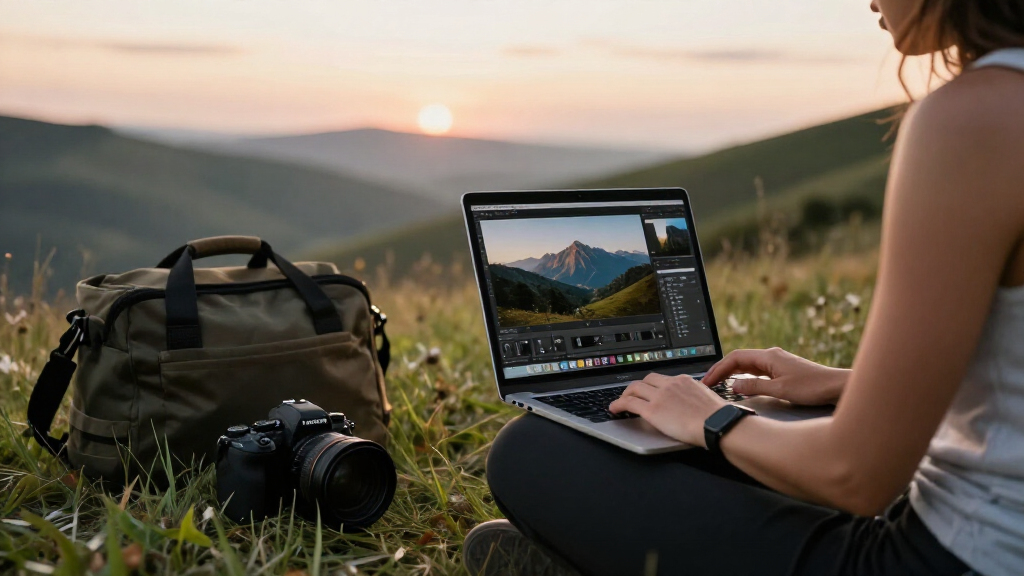
How We Picked
My selection process focused on three core metrics relevant to photo editing: single-core performance for Lightroom responsiveness, multi-core performance for batch exports, and memory bandwidth for handling large RAW files. I prioritized models with at least 18GB of unified memory, as 8GB configurations are no longer sufficient for professional workflows involving multiple applications. The ranking logic favors machines that maintain consistent performance under load, meaning models with better cooling systems in the 14-inch chassis were preferred over underpowered alternatives.
I also weighed display quality heavily, as color accuracy is non-negotiable for photographers. All selected models feature Liquid Retina XDR displays, but I differentiated them based on sustained brightness levels and color gamut coverage. The final list excludes older Intel-based Macs and base-model M-series chips with insufficient RAM, as these represent poor value for professional creative work in 2027.
| macbook pro for photographers and lightroom | Chip | Ports |
|---|---|---|
| Apple 2024 MacBook Pro 14-inch | Apple M4 Pro | — |
| Apple MacBook Pro 16.2-inch wi | — | Three Thunderbolt 5, MagSafe 3, SDXC, HDMI |
| Apple MacBook Pro 14-inch with | M5 Max | Three Thunderbolt, HDMI, MagSafe 3, SDXC |
| Apple MacBook Pro 14.2-inch wi | — | Three Thunderbolt 5, MagSafe 3, SDXC, HDMI |
| Apple MacBook Pro 16-inch with | Apple M5 Pro | — |
| Apple 2025 MacBook Pro 14.2-in | Apple M5 | Three Thunderbolt 4, MagSafe 3, SDXC, HDMI |
| Apple 2026 MacBook Pro 16.3-in | — | Three Thunderbolt 5, MagSafe 3, SDXC, HDMI |
Factors to Consider When Choosing Macbook Pro For Photographers And Lightroom
Selecting a MacBook Pro for photography isn’t just about picking the fastest chip. You must align your hardware capabilities with your specific workflow volume, file sizes, and portability needs. Here are the critical factors to weigh before making your investment.
CPU Architecture and Core Count
Lightroom benefits significantly from high single-core clock speeds, which drive responsiveness when moving sliders or navigating the Library module. However, multi-core performance becomes vital when you initiate batch exports or apply AI-driven denoising and masking features. The M4 and M5 Pro chips strike a balance, but the M5 Max offers a 40-core GPU that accelerates these AI tasks dramatically. If you primarily shoot stills, you rarely need the extreme multi-core power of the Max, making the Pro chips a more cost-effective choice for pure photography work.
Unified Memory: The Bottleneck Breaker
Unified memory allows the CPU and GPU to access the same data pool, reducing latency. For Lightroom, 24GB is the practical minimum for a smooth experience with large catalogs and simultaneous Photoshop use. Going below this threshold forces the system to swap data to the SSD, causing noticeable lag during intensive editing sessions. While 64GB or 128GB configurations exist, they are generally reserved for photographers who also handle 3D rendering or heavy video compositing, as standard photo editing rarely saturates 32GB of RAM.
Storage Speed and Capacity Strategy
Internal SSD speed impacts how quickly Lightroom loads previews and caches. The M-series drives are incredibly fast, but capacity is where many buyers falter. I recommend buying a smaller internal SSD (512GB or 1TB) and relying on high-speed external Thunderbolt SSDs for your photo library. This approach saves money compared to Apple’s expensive internal storage upgrades and allows you to carry your entire catalog between machines seamlessly. Ensure the external drive matches your internal drive’s speed to avoid workflow bottlenecks.
Display Color Accuracy and Size
The Liquid Retina XDR display is a standard across these picks, but size affects your editing comfort. The 14-inch screen is portable but requires an external monitor for detailed retouching. The 16-inch model offers enough screen real estate to edit directly on the laptop, displaying both the module panel and a large preview simultaneously. For photographers who travel light, the 14-inch is superior, but if you work primarily at a desk, the 16-inch reduces the need for external hardware, simplifying your setup.
Thermal Management and Sustained Performance
Short bursts of power are easy for any M-series chip, but sustained exports generate heat. The 16-inch chassis dissipates heat more effectively than the 14-inch, meaning the fans spin less aggressively and performance remains consistent over long sessions. If you frequently export hundreds of images or run video encodes, the larger cooling system in the 16-inch models prevents thermal throttling. For occasional edits, the 14-inch models remain quiet and efficient enough for daily use.
Frequently Asked Questions
Is 16GB of memory enough for Lightroom in 2027?
For a beginner with a small catalog of JPEGs or small RAW files, 16GB might suffice for basic adjustments. However, for any serious photography workflow involving high-megapixel cameras, 24GB is the recommended baseline. Lightroom caches previews heavily, and running it alongside Photoshop and a web browser will quickly exhaust 16GB, leading to sluggish performance and potential crashes. Investing in more memory upfront is cheaper than dealing with workflow interruptions later.
Do I need the M5 Max chip for photography?
The M5 Max is overkill for pure still photography in Lightroom. Its primary advantage lies in its massive GPU core count, which accelerates video editing and complex 3D rendering. For photographers who only edit images, the M4 Pro or M5 Pro chips provide indistinguishable performance during daily editing tasks. You should only consider the Max if your workflow includes heavy video production or if you want to future-proof your machine for several years without thinking about specs.
Which is better for photographers: 14-inch or 16-inch MacBook Pro?
This depends entirely on your portability needs. The 14-inch model is significantly lighter and easier to carry in a camera bag, making it ideal for travel photographers who edit on location. The 16-inch model offers a larger canvas for detailed retouching and better thermal performance, but it is heavier and less convenient for travel. If you have a fixed home studio, the 16-inch is more comfortable; if you move around, the 14-inch is the practical choice.
Can I use an external monitor with these MacBook Pro models?
Yes, all these models support multiple external displays via Thunderbolt and HDMI ports. The Pro and Max chips support up to three external displays, while the base M5 supports two. This is a critical feature for photographers who need a color-calibrated monitor for critical editing while keeping the laptop screen for tool panels. Ensure you use high-quality Thunderbolt cables to maintain signal integrity and 4K resolution at 60Hz or higher.
Is the ProLED XDR display worth the extra cost for photo editing?
The ProLED XDR display offers higher sustained brightness and deeper blacks than standard OLED or LCD screens, which is beneficial for HDR photography. However, for standard sRGB or Adobe RGB workflows, the difference is subtle. If you are a landscape photographer who shoots HDR brackets or a commercial photographer working with high-contrast images, the enhanced dynamic range is valuable. For portrait or general photography, the standard Liquid Retina XDR displays on other models are already excellent and more budget-friendly.
Conclusion
Choosing the right MacBook Pro for photographers and Lightroom comes down to matching your workflow intensity with the correct chip and memory configuration. For the vast majority of users, the Apple 2024 MacBook Pro 14-inch with M4 Pro is the best overall pick, delivering professional-grade performance in a portable package at a reasonable price point. If you handle massive catalogs and require desktop-like power in a laptop form factor, the MacBook Pro 16.2-inch with M5 Pro is the best premium choice, offering superior cooling and screen space. Beginners or those with tighter budgets should look at the Apple 2025 MacBook Pro 14-inch with M5, provided they can manage with 16GB of RAM, though upgrading to 24GB is strongly advised. Avoid the extreme M5 Max configurations unless you also edit video, as they represent unnecessary expenditure for pure still photography.