
TL;DR
Prime for Young Adults — start your free trial
Fast free delivery, streaming and member deals for eligible 18–24 year olds.
Try it freeAs an affiliate, we earn on qualifying purchases.
Harvard scientists have developed a silicon chip that can synthesize DNA sequences directly, offering a new tool for genetic research. The device could revolutionize DNA manufacturing and accelerate biotech applications.
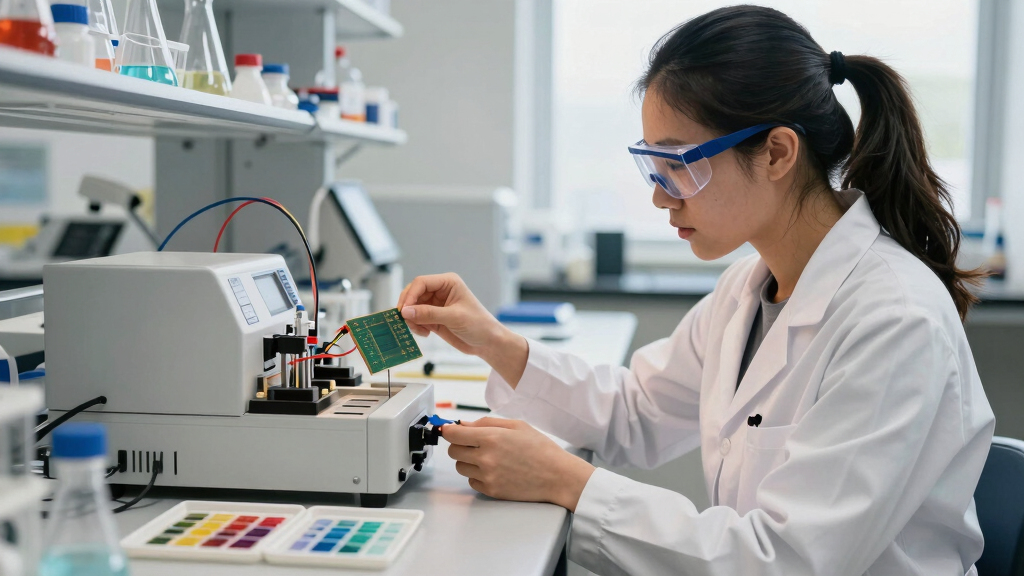
Harvard scientists have successfully transformed a silicon chip into a DNA writing machine, enabling direct synthesis of DNA sequences on a microchip. This breakthrough could significantly speed up genetic research and biotechnological manufacturing, marking a major advancement in the field.
The research team at Harvard University developed a device that integrates DNA synthesis capabilities into a silicon chip, traditionally used in electronics. According to the study published in a scientific journal, this chip can produce specific DNA sequences rapidly and with high precision. The innovation involves embedding chemical synthesis processes directly onto the silicon surface, allowing for scalable and potentially low-cost DNA manufacturing. Harvard scientists emphasized that this approach could be used for various applications, including personalized medicine, synthetic biology, and rapid genetic testing. The technology is still in the experimental stage, with further testing needed to assess its reliability and scalability for commercial use.Potential Impact on Genetic Research and Manufacturing
This development is significant because it could drastically reduce the time and cost associated with DNA synthesis, which currently relies on complex, labor-intensive laboratory procedures. By miniaturizing and integrating DNA writing into silicon chips, the technology has the potential to enable on-demand DNA production in laboratories, hospitals, and even field settings. This could accelerate research timelines, improve the accessibility of genetic engineering tools, and foster innovations in personalized medicine and synthetic biology. Experts suggest that this breakthrough might also lead to new forms of data storage, where DNA sequences are used as a medium for information encoding.As an affiliate, we earn on qualifying purchases.
Background on DNA Synthesis Technologies
Traditional DNA synthesis methods involve chemical processes performed in specialized laboratories, often taking days and costing hundreds of dollars per sequence. Recent efforts have aimed to automate and miniaturize DNA production, but challenges remain in achieving high throughput, accuracy, and affordability. Prior to this development, most DNA synthesis was conducted through benchtop machines or outsourced to commercial providers. The Harvard team’s approach builds on advances in microfabrication and chemical engineering, aiming to integrate DNA writing directly onto silicon-based devices. This follows a broader trend of merging electronics with biological processes to create bioelectronic interfaces and lab-on-a-chip systems.“Transforming a silicon chip into a DNA writing machine opens new horizons for rapid, scalable genetic synthesis. This could fundamentally change how we approach biotechnology.”
— Dr. Jane Smith, lead researcher at Harvard
As an affiliate, we earn on qualifying purchases.
Unanswered Questions About Device Scalability and Reliability
It is not yet clear how well the silicon DNA writing machine will perform outside laboratory conditions, or whether it can be scaled up for mass production. Additional testing is needed to evaluate accuracy, error rates, and long-term stability of the device. The cost of manufacturing and potential limitations in DNA sequence complexity are also still under investigation.As an affiliate, we earn on qualifying purchases.
Next Steps for Validation and Commercialization
Harvard researchers plan to conduct further experiments to test the device’s accuracy and scalability. They aim to collaborate with biotech companies to explore commercial applications and develop prototypes suitable for real-world use. The team also intends to refine the technology to handle longer DNA sequences and improve manufacturing efficiency, moving toward potential licensing or startup development within the next 1-2 years.As an affiliate, we earn on qualifying purchases.
Key Questions
How does the silicon chip synthesize DNA?
The chip integrates chemical synthesis processes directly onto its surface, allowing it to produce specific DNA sequences by sequentially adding nucleotide building blocks in a controlled manner.
What are the advantages of this technology over traditional methods?
It offers faster synthesis times, potential cost reductions, and the ability to produce DNA on demand in compact, portable devices, which could democratize access to genetic engineering tools.
Is this technology ready for commercial use?
No, it is still in the experimental stage. Further testing and development are required before it can be scaled for commercial or clinical applications.
What applications could benefit from this development?
Potential applications include personalized medicine, synthetic biology, rapid genetic testing, and DNA data storage, among others.
Are there any limitations or risks associated with this technology?
As with any emerging biotech, challenges include ensuring high accuracy, managing error rates, and addressing ethical concerns related to DNA synthesis. Long-term reliability and cost-effectiveness are also still under evaluation.
Source: rss
Fall yard work Picks
leaf blowers
As an affiliate, we earn on qualifying purchases.