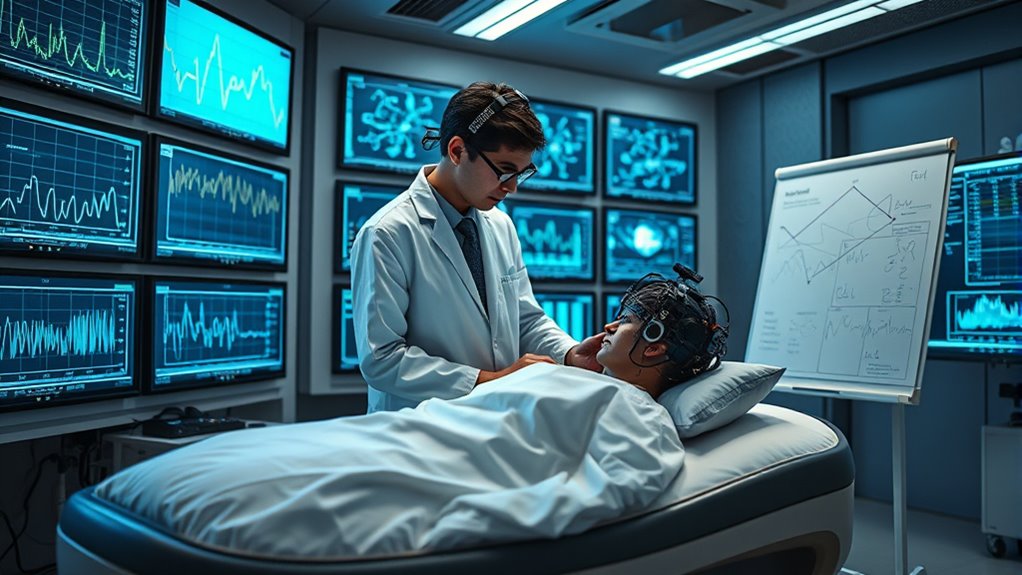

Scientific studies on precognitive dreaming suggest that while some believe dreams can predict future events, evidence remains limited and debated. Researchers explore how dream recall varies and how sleep stages influence dream content, especially in REM sleep. Although neuroimaging offers insights, many reports rely on subjective accounts, making it hard to distinguish coincidence from genuine precognition. If you want to understand what current science really says about these mysterious dreams, there’s more to uncover here.
Key Takeaways
- Scientific research on precognitive dreaming remains inconclusive due to challenges in verifying predictive content and reliance on subjective reports.
- Neuroimaging studies investigate brain activity during REM sleep to understand potential subconscious processes involved in precognition.
- Few documented cases show consistent, verifiable instances of dreams predicting future events, often debated as coincidences or memory biases.
- Dream recall variability impacts the ability to analyze and validate predictive dreams scientifically.
- Ongoing studies aim to differentiate genuine precognitive phenomena from chance, emphasizing rigorous methodology and objective measurement.

Scientific studies on precognitive dreaming explore whether dreams can predict future events, a concept that has fascinated researchers for decades. If you’ve ever woken up feeling that a dream foretold something important, you’re not alone. Scientists have long debated whether these experiences are mere coincidences or if they reveal something deeper about our subconscious mind. To understand this, researchers often focus on how well people remember their dreams, known as dream recall, and what happens during different sleep stages. Dream recall varies markedly from person to person; some remember vivid details, while others forget their dreams altogether. This variability influences how scientists interpret data on precognitive dreaming because if you don’t recall your dreams clearly, it’s hard to determine if they contained any predictive content.
Dream recall variability affects the study of precognitive dreams and their predictive potential.
Sleep stages are essential in understanding when dreams occur and how they might relate to future events. REM sleep, in particular, is associated with vivid dreaming, and many studies focus on this stage to analyze dream content. During REM, your brain is highly active, similar to waking consciousness, which makes it the prime window to investigate whether dreams can hold predictive clues. Some research suggests that dreams during REM might sometimes incorporate subconscious knowledge about upcoming events, although this remains highly debated. Conversely, non-REM sleep features more subdued brain activity, and dreams during this stage tend to be less vivid and more fragmented, making it harder to analyze their predictive potential. Additionally, advancements in neuroimaging techniques are providing new insights into how different sleep stages affect dream formation and recall, which could eventually clarify their connection to precognition. Moreover, understanding the neural mechanisms involved in dreaming could help differentiate between coincidence and genuine precognitive phenomena. Furthermore, the complexity of neural activity during sleep adds to the challenge of interpreting dream content accurately. Some studies also suggest that individual differences in neural activity may influence the likelihood of experiencing precognitive dreams.
Researchers utilize various methods to explore the connection between sleep stages, dream recall, and precognitive phenomena. For example, they might record brain activity during sleep while asking participants to journal their dreams upon waking. By comparing dream content with actual future events, scientists aim to identify patterns or anomalies that could indicate precognition. However, the challenge lies in the rarity and inconsistency of such reports, which makes it difficult to draw firm conclusions. Critics argue that many seemingly predictive dreams are simply coincidences or products of selective memory, especially since people tend to forget the majority of their dreams. The subjective nature of dream reports further complicates the scientific analysis of precognitive dreams.
Despite these hurdles, some researchers believe that studying sleep stages and dream recall can shed light on the mechanisms behind precognitive dreaming. While definitive proof remains elusive, ongoing research continues to probe whether our subconscious mind might hold more knowledge about the future than we realize. For now, the connection between dream recall, sleep stages, and precognition remains an intriguing mystery—one that challenges our understanding of consciousness and the mind’s hidden depths. Exploring the neural mechanisms behind dreaming could eventually help clarify whether precognitive dreams are genuine phenomena or psychological artifacts. Continued advancements in neuroimaging techniques are promising tools for uncovering the complex interactions that occur during dreaming and their potential relation to precognition. Overall, these studies contribute to a broader understanding of the sleep and dreaming process and its possible connection to future insights. Some theories also propose that the brain’s ability to predict future events might be reflected in certain types of dream content, though this remains speculative.
neuroimaging sleep study equipment
As an affiliate, we earn on qualifying purchases.
As an affiliate, we earn on qualifying purchases.
Frequently Asked Questions
Can Precognitive Dreams Predict Specific Future Events Reliably?
You might wonder if precognitive dreams can reliably predict specific future events. Scientific research shows that, through statistical analysis and careful dream journaling, there’s little evidence supporting consistent accuracy. While some dreamers recall vivid premonitions, most predictions are coincidental or vague. Keep in mind that the mind’s pattern recognition can create false links, so relying on dreams for precise forecasts isn’t currently supported by solid scientific data.
How Do Scientists Differentiate Between Coincidence and True Precognition?
Delving into doubts, you wonder how scientists distinguish between coincidence and true precognition. They examine dream recall accuracy and analyze patterns for statistical significance, ensuring results aren’t random. By comparing dreams to actual events over time, they identify meaningful matches. This meticulous method helps determine if dreams genuinely predict the future or simply mirror chance, making the mysteries of precognitive dreaming more manageable and measurable.
Are There Psychological Explanations for Precognitive Dreams?
You might wonder if psychological explanations like subconscious influence and cognitive biases explain precognitive dreams. These dreams could stem from your mind unconsciously processing recent events or patterns, leading you to believe you’ve predicted the future. Your biases might also cause you to remember hits more than misses, reinforcing the illusion of precognition. While intriguing, these psychological factors offer plausible explanations without needing to invoke extrasensory abilities.
What Technologies Are Used to Study Precognitive Dreaming Scientifically?
In the domain of dreams, your mind becomes a lighthouse guiding exploration. Scientists use advanced neuroscience experiments and sleep monitoring devices to decode this luminous signal. These tools track brain activity, eye movements, and sleep stages, revealing patterns linked to precognitive dreaming. By capturing this hidden dialogue between subconscious and conscious, researchers aim to understand whether your dreams can glimpse into future events, revealing the secrets of the mind’s prophetic tapestry.
Is There Any Cultural Bias in Reports of Precognitive Dreams?
You might wonder if cultural influence affects reports of precognitive dreams. It’s likely that report bias exists, shaped by cultural beliefs and expectations. Some cultures may be more open or skeptical about such experiences, influencing how people perceive and share their dreams. These cultural factors can skew data, making it seem like precognitive dreaming is more common or accepted in certain societies, even if the phenomenon is universal.

Compendium Softcover Journal – “Who looks outside, dreams. Who looks inside, awakens.”— A Write Now Journal with 128 Lined Pages, 5"W x 8"H
MAKE A STATEMENT: This designer softcover journal features calming sentiments, modern typography, and artwork by contemporary designers and…
As an affiliate, we earn on qualifying purchases.
As an affiliate, we earn on qualifying purchases.
Conclusion
While scientific studies on precognitive dreaming are limited, they suggest it’s a fascinating area worth exploring. Imagine dreaming about a friend’s job loss, only to find out weeks later that it happened. Such cases spark curiosity and challenge our understanding of consciousness. Though proof remains elusive, continuing research might someday reveal how your dreams could hint at future events—inviting you to see your nightly visions in a whole new light.

RingConn Gen 2, World’s First Smart Ring with Sleep Apnea Monitoring, No APP Subscription, 12-Day Battery Life, Stress/Heart Rate/Women's Health Tracker, Android & iOS Compatible (Silver, Size 10)
[Sleep Apnea Monitoring] RingConn Gen 2 Smart Ring supports sleep health with advanced technology. Developed with leading universities…
As an affiliate, we earn on qualifying purchases.
As an affiliate, we earn on qualifying purchases.

Owlet Dream Duo (Gen 3) Smart Baby Monitor All-in-One Bundle – 2K HD Video Baby Monitor with Alerts & Owlet Dream Sock Tracks Baby’s Oxygen, Heart Rate & Sleep | Health Insights via App | Bedtime Blue
What is the Owlet Dream Duo? Dream Duo is Owlet's most advanced monitoring system, combining the FDA-cleared Dream…
As an affiliate, we earn on qualifying purchases.
As an affiliate, we earn on qualifying purchases.