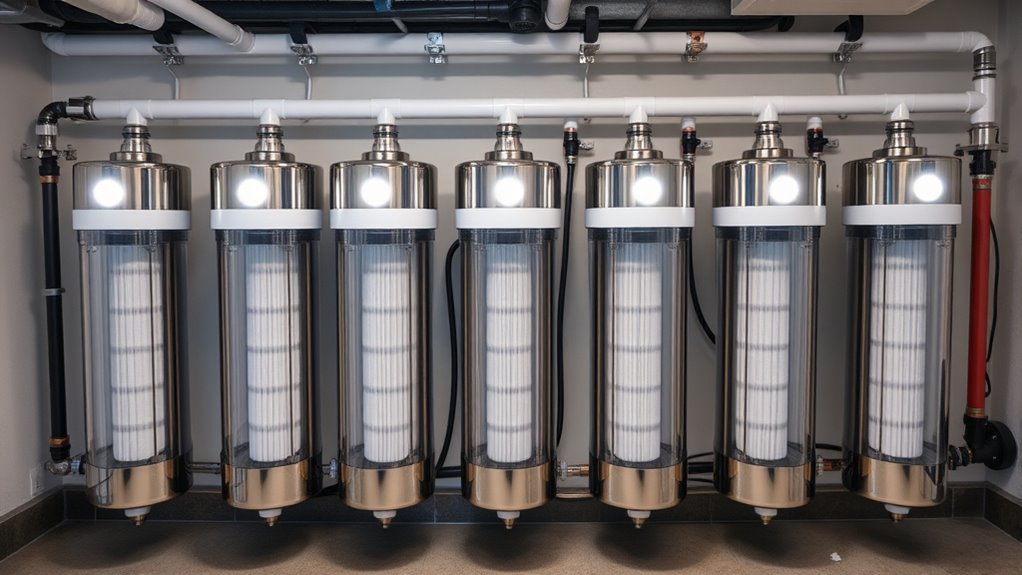

A whole house water filter system treats water at the point it enters your home, but the right choice depends on what is in your supply and which tradeoffs you can live with. My best overall pick is the Express Water Ultimate Protection 3-Stage System for its multi-stage approach; the HQUA WF3-03 stands out for homes that want UV treatment, while the iSpring WGB32BM targets iron and manganese. Simpler carbon and sediment systems can be easier to maintain, while broader treatment setups may take more space, upkeep, and installation work. Read on for the full comparison and guidance on matching a system to your water report, plumbing, and household needs.

Get health and wellness essentials delivered free with Prime
- Fast, free delivery on millions of items
- Prime Video, Amazon Music and more included
- Member-only deals all year
Key Takeaways
- Multi-stage filtration is the roundup’s strongest all-around pattern: Express Water’s Ultimate Protection model combines several treatment stages, while simpler systems trade breadth for fewer components.
- UV is a targeted add-on, not a general upgrade: HQUA WF3-03 and Aquasana Rhino include UV, making them distinct options for buyers concerned about microbial treatment.
- Well-water concerns call for specific media: iSpring WGB32BM is the lineup’s clearest fit for iron and manganese, rather than a default pick for every household.
- Chlorine and chloramine needs favor carbon-focused choices: Clean Home emphasizes high-capacity carbon treatment, while the Pentair OMNIFilter U25 offers a simpler, more compact format.
- System complexity changes the ownership experience: Three-stage and UV-equipped setups can address more treatment needs, but buyers should account for space, filter changes, and installation before choosing them over two-stage options.
| Pentair OMNIFilter U25 Whole House Water Filter System, 10 x 2.5 in, Valve-in-Head |  | Best for Simple, Compact Filtration | Filter size: 10 x 2.5 in | Connections: 3/4 in NPT | Included cartridge: OMNIFilter TO1 carbon wrap | VIEW ON AMAZON | See Our Full Breakdown |
| Express Water Ultimate Protection 3-Stage Whole House Water Filter System |  | Best for High Flow and Reusable Sediment Pre-Filtration | Filtration stages: 3 | Sediment pre-filter: Reusable 50-micron spin-down filter | Purification methods: Activated carbon, heavy metal filtration, anti-scale | VIEW ON AMAZON | See Our Full Breakdown |
| Express Water 3-Stage Whole House Water Filter System |  | Best for Heavy-Metal and Scale Treatment | Filtration stages: 3 | Purification methods: Activated carbon, KDF, polyphosphate | Maximum flow rate: 17 gpm | VIEW ON AMAZON | See Our Full Breakdown |
| HQUA WF3-03 3-Stage Whole House Water Filtration System with UV Filter | 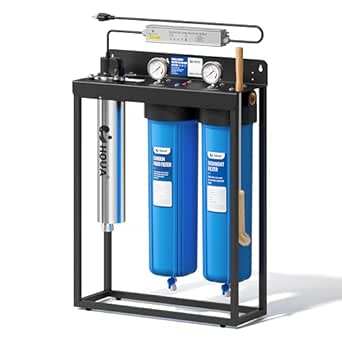 | Best for UV Treatment | Filtration stages: 3 | UV filter: HQUA TWS-12, 55W | Maximum flow rate: 15 gpm | VIEW ON AMAZON | See Our Full Breakdown |
| Express Water 3-Stage Whole House Water Filter System |  | Best for Chlorine Taste and Odor | Filtration stages: 3 | Purification method: Activated carbon, granular activated carbon | Maximum flow rate: 17 gpm | VIEW ON AMAZON | See Our Full Breakdown |
| Clean Home Whole House Water Filter System – High-Capacity Carbon Filter for Chlorine & Chloramine Reduction, Up to 600,000 Gallons, Includes Pre-Filter Kit and Replacement Filter | 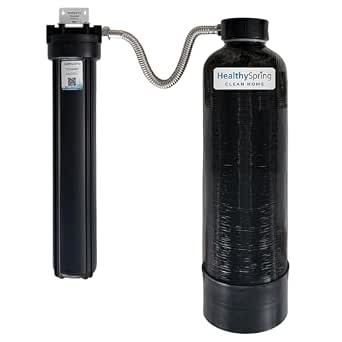 | Best for Long-Lasting Chloramine Reduction | Filtration method: Granular catalytic activated carbon and sedimentation | Maximum flow rate: 7 GPM | Pre-filter: 20-inch, 27-micron | VIEW ON AMAZON | See Our Full Breakdown |
| iSpring WGB32BM 3-Stage Whole House Water Filter System for Iron and Manganese |  | Best for Iron and Manganese | Filtration stages: 3 | Iron reduction: Up to 3.0 ppm | Manganese reduction: Up to 1.0 ppm | VIEW ON AMAZON | See Our Full Breakdown |
| iSpring WGB21B Two-Stage Whole House Water Filtration System | 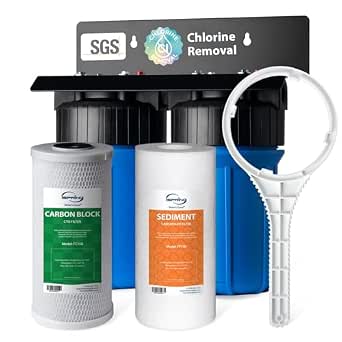 | Best for Straightforward, Lower-Complexity Filtration | Filtration stages: 2 | Sediment filter: 5-micron polypropylene | Carbon filter: CTO carbon block | VIEW ON AMAZON | See Our Full Breakdown |
| iSpring WGB32B 3-Stage Whole House Water Filter System |  | Best for Higher-Capacity Carbon Filtration | Filtration stages: 3 | Filter types: 5-micron sediment filter and two CTO carbon block filters | Chlorine reduction: Up to 99% | VIEW ON AMAZON | See Our Full Breakdown |
| Aquasana Rhino Whole House Water Filter System with UV and Salt-Free Scale Control |  | Best Premium Multi-Stage System | Model: WH-1000-CS-UVS-B | Filtration methods: Carbon, copper-zinc KDF, salt-free scale control, UV, sediment filtration | Capacity: Up to 1,000,000 gallons | VIEW ON AMAZON | See Our Full Breakdown |
| whole house water filter system | Maximum flow rate | Capacity | Filtration stages | Operating pressure |
|---|---|---|---|---|
| Pentair OMNIFilter U25 Whole H | 5 gpm | — | — | — |
| Express Water Ultimate Protect | 17 gpm | 100,000 gallons | 3 | 20–80 psi |
| Express Water 3-Stage Whole Ho | 17 gpm | 100,000 gallons | 3 | 20–80 psi |
| HQUA WF3-03 3-Stage Whole Hous | 15 gpm | 100,000 gallons | 3 | 25–116 PSI |
| Express Water 3-Stage Whole Ho | 17 gpm | 100,000 gallons | 3 | 20–80 psi |
| Clean Home Whole House Water F | 7 GPM | — | — | — |
| iSpring WGB32BM 3-Stage Whole | 15 GPM | 100,000 gallons | 3 | 25–80 psi |
| iSpring WGB21B Two-Stage Whole | 15 GPM | Up to 50,000 gallons | 2 | Up to 80 psi |
| iSpring WGB32B 3-Stage Whole H | 15 GPM | 100,000 gallons | 3 | 25–80 psi |
| Aquasana Rhino Whole House Wat | 14.6 GPM | Up to 1,000,000 gallons | — | — |
More Details on Our Top Picks
Pentair OMNIFilter U25 Whole House Water Filter System, 10 x 2.5 in, Valve-in-Head
I’d choose the Pentair OMNIFilter U25 for a straightforward whole-house setup aimed at reducing sediment and chlorine taste or odor, not for broad contaminant treatment. Its valve-in-head design lets you change the cartridge without shutting off the main supply, while the clear sump makes it easier to see when the filter needs attention. At just 4 pounds, it is much smaller and lighter than the 63-pound Express Water WH300SCKP, but that compactness comes with a 5 gpm maximum flow rate and a single 10 x 2.5-inch cartridge rather than a three-stage treatment train. The included cartridge is intended for chlorinated supplies and has a 15,000-gallon capacity, with replacement recommended about every three months. I’d skip it for high-demand homes or buyers seeking heavy-metal, scale, or UV treatment.
Pros:- Reduces sediment, chlorine taste, and odor.
- Built-in valve allows cartridge changes without shutting off the main water supply.
- Clear housing makes cartridge condition visible.
- Accepts several compatible cartridge types, including TO1, RS1, CB3, and GAC1.
Cons:- Maximum flow rate is 5 gpm, well below the 15–17 gpm ratings of the larger systems here.
- The included cartridge is designed for chlorinated water supplies, limiting its fit for other water concerns.
- The stated 15,000-gallon capacity and roughly three-month replacement interval mean frequent maintenance.
Best for: Households seeking a compact, basic whole-house sediment and chlorine taste-and-odor filter with simpler cartridge changes.
Not ideal for: Large households with simultaneous high water demand, or buyers who need stated heavy-metal reduction, scale control, or UV treatment.
- Filter size:10 x 2.5 in
- Connections:3/4 in NPT
- Included cartridge:OMNIFilter TO1 carbon wrap
- Compatible cartridges:TO1, RS1, CB3, GAC1
- Cartridge capacity:15,000 gallons
- Filter life:Approximately 3 months
- Maximum flow rate:5 gpm
- Dimensions and weight:4 x 4 x 25 in; 4 lb
Our verdict“Choose the U25 for compact, basic sediment and chlorine filtration, but pick a higher-flow multi-stage system for a busy home or broader treatment needs.”
Express Water Ultimate Protection 3-Stage Whole House Water Filter System
The Express Water Ultimate Protection WH300SCKP-S is the strongest fit here for households that want high flow alongside a reusable sediment stage. Its 50-micron spin-down pre-filter can be rinsed and reused, helping catch larger particles before they reach the other stages; that differs from the cartridge-only Pentair OMNIFilter U25, which is simpler but has a lower 5 gpm maximum flow. This system is rated up to 17 gpm and 100,000 gallons, with pressure gauges and quick-change cartridges that give owners a way to monitor and service the setup. Its stated treatment includes sediment, chlorine, heavy metals, and scale. The tradeoff is a 66-pound, 29 x 8.5 x 30-inch installation that needs room and support, plus a six-month filter-life cycle. I’d favor it over the other Express Water models when reusable pre-filtration is a priority.
Pros:- Reusable 50-micron spin-down sediment filter helps protect the downstream stages.
- Maximum flow rate of 17 gpm suits higher-demand whole-house use.
- Pressure gauges and quick-change cartridges aid routine monitoring and service.
- Rated capacity is up to 100,000 gallons.
Cons:- At 66 pounds and 29 x 8.5 x 30 inches, it requires substantial installation space and support.
- Cartridges have a stated six-month filter-life cycle.
- Its three-stage treatment setup is more involved than the compact Pentair U25.
Best for: Households with higher simultaneous water demand that want a reusable sediment pre-filter and monitoring gauges.
Not ideal for: Homeowners with limited utility-room space, or anyone seeking a lightweight system that needs little installation support.
- Filtration stages:3
- Sediment pre-filter:Reusable 50-micron spin-down filter
- Purification methods:Activated carbon, heavy metal filtration, anti-scale
- Connections:1-inch standard connections
- Maximum flow rate:17 gpm
- Capacity:100,000 gallons
- Filter life cycle:6 months
- Operating pressure:20–80 psi
- Dimensions and weight:29 × 8.5 × 30 in; 66 lb
Our verdict“Pick this Express Water model if high flow and reusable sediment pre-filtration outweigh its size and scheduled cartridge upkeep.”
Express Water 3-Stage Whole House Water Filter System
I’d put the Express Water WH300SCKP on the shortlist when a buyer wants a three-stage system specifically described as reducing several heavy metals while helping limit scale buildup. Its stated media include activated carbon, KDF, and polyphosphate, a broader treatment focus than the chlorine-and-taste emphasis of the Express Water WH300SCGS. Pressure gauges and release buttons also give owners practical ways to monitor pressure and relieve it during filter changes. Like the Ultimate Protection WH300SCKP-S, it is rated for 17 gpm and 100,000 gallons, but this version does not list a reusable spin-down sediment pre-filter. That makes it less compelling if reusable sediment management is the main goal. At 63 pounds and 29 x 8.5 x 30 inches, it also needs a dedicated installation area, and its filters have a six-month cycle.
Pros:- Designed to reduce chlorine and multiple listed heavy metals.
- Polyphosphate stage is intended to help prevent scale buildup in pipes and appliances.
- Pressure gauges and release buttons support monitoring and filter changes.
- Rated for up to 17 gpm and 100,000 gallons.
Cons:- Filters have a stated six-month replacement cycle.
- The 63-pound, freestanding unit takes substantial space and support.
- Unlike the WH300SCKP-S, the listed setup does not include a reusable spin-down sediment pre-filter.
Best for: Homeowners seeking a whole-house multi-stage system whose stated treatment includes lead, arsenic, chromium, mercury, cadmium, and scale buildup.
Not ideal for: Buyers who prioritize a reusable sediment pre-filter, UV treatment, or a compact installation.
- Filtration stages:3
- Purification methods:Activated carbon, KDF, polyphosphate
- Maximum flow rate:17 gpm
- Operating pressure:20–80 psi
- Capacity:100,000 gallons
- Filter life cycle:6 months
- Dimensions and weight:29 × 8.5 × 30 in; 63 lb
- Warranty:1 year
Our verdict“Choose the WH300SCKP for its stated heavy-metal and scale focus, unless reusable sediment pre-filtration or UV treatment is a higher priority.”
HQUA WF3-03 3-Stage Whole House Water Filtration System with UV Filter
The HQUA WF3-03 is the clear choice in this group for buyers who want UV treatment added to whole-house filtration. Along with three filtration stages, its 55W UV unit is intended to address microorganisms, while the system is also described as reducing sediment, chlorine, odors, selected heavy metals, and PFAS. That gives it a different purpose from the Express Water WH300SCKP, whose listed treatment emphasizes heavy metals and scale but does not include UV. The HQUA is rated up to 15 gpm—slightly below the 17 gpm Express Water systems—and can be freestanding or wall-mounted. Three pressure gauges, three timers, and maintenance accessories help organize upkeep. The tradeoffs are a 44-pound, 28-inch-tall assembly and scheduled cartridge maintenance; buyers should also account for the UV component when planning service.
Pros:- Combines three filtration stages with a 55W UV filter.
- Described as reducing sediment, chlorine, odors, selected heavy metals, PFAS, and microorganisms.
- Can be installed freestanding or wall-mounted.
- Includes pressure gauges, filter-life timers, and maintenance accessories.
Cons:- Its 15 gpm maximum flow rate is below the 17 gpm ratings of the Express Water WH300SCKP models.
- The 44-pound, 22 x 9.5 x 28-inch system needs dedicated installation space.
- Scheduled cartridge and UV-system maintenance adds upkeep beyond a basic carbon filter.
Best for: Households seeking a whole-house setup that combines filtration with UV treatment for microorganism concerns.
Not ideal for: Buyers who only need basic chlorine and sediment reduction, or who lack room and capacity for a large multi-part system.
- Filtration stages:3
- UV filter:HQUA TWS-12, 55W
- Maximum flow rate:15 gpm
- Capacity:100,000 gallons
- Inlet and outlet:1 in FNPT
- Operating pressure:25–116 PSI
- Installation:Freestanding or wall-mounted
- Dimensions and weight:22 x 9.5 x 28 in; 44 lb
Our verdict“Choose the HQUA WF3-03 when UV treatment is a priority; choose an Express Water system instead if higher stated flow or scale-focused treatment matters more.”
Express Water 3-Stage Whole House Water Filter System
The Express Water WH300SCGS makes the most sense when the main household complaint is chlorine taste or smell across multiple taps. Its three-stage setup uses activated carbon and granular activated carbon, with pressure gauges and release buttons to help monitor the system and service filters. Compared with the WH300SCKP, which lists KDF, polyphosphate, and treatment for multiple heavy metals and scale, this model has a more focused carbon-based brief. It is also rated for 17 gpm and 100,000 gallons, far above the Pentair U25’s 5 gpm, though its 62-pound frame is much less compact. Filter replacement is recommended every six to 12 months or 100,000 gallons, depending on usage and water quality. I’d skip it if UV or explicit heavy-metal treatment is the main requirement.
Pros:- Three-stage activated and granular activated carbon treatment targets chlorine taste and odor.
- Maximum flow rate of 17 gpm supports whole-house use.
- Pressure gauges and release buttons help with monitoring and filter service.
- Listed capacity is up to 100,000 gallons, with a stated 6–12-month replacement range.
Cons:- At 62 pounds and 23 x 8 x 29 inches, it needs more installation space than the Pentair U25.
- Filters need periodic replacement, with timing dependent on water quality and usage.
- Its listed treatment is less specialized for heavy metals, scale, or microorganisms than other systems in this group.
Best for: Households looking to reduce chlorine taste and odor throughout the home and wanting gauges to monitor a three-stage system.
Not ideal for: Buyers seeking UV treatment, a reusable sediment pre-filter, or the listed heavy-metal and scale focus of the WH300SCKP.
- Filtration stages:3
- Purification method:Activated carbon, granular activated carbon
- Maximum flow rate:17 gpm
- Connection size:1 inch
- Capacity:100,000 gallons
- Filter replacement schedule:Every 6–12 months or 100,000 gallons
- Operating pressure:20–80 psi
- Dimensions and weight:23 x 8 x 29 in; 62 lb
Our verdict“Choose the WH300SCGS for whole-house chlorine taste and odor reduction, but look to the HQUA for UV or the WH300SCKP for a stated heavy-metal and scale focus.”
Clean Home Whole House Water Filter System – High-Capacity Carbon Filter for Chlorine & Chloramine Reduction, Up to 600,000 Gallons, Includes Pre-Filter Kit and Replacement Filter
I’d shortlist this system for households focused on chlorine and chloramine taste and odor that want fewer carbon-media changes. Its stated capacity of up to 600,000 gallons is well above the iSpring WGB21B’s 50,000-gallon rating, though actual service life depends on water use and conditions. A 27-micron, 20-inch sediment pre-filter catches larger particles before they reach the catalytic carbon, and the included replacement filter gives buyers another cartridge on hand. The tradeoff is a stated 7 GPM maximum flow rate, below the 15 GPM ratings of both iSpring systems here, so it may be a weaker fit for homes with several fixtures running at once. I’d also verify whether that flow rate meets the household’s peak demand before choosing it.
Pros:- Catalytic carbon is specified for chlorine and chloramine reduction throughout the home.
- Rated capacity of up to 600,000 gallons is higher than the listed capacities of the iSpring systems in this roundup.
- Includes a 20-inch, 27-micron sediment pre-filter and an additional replacement filter.
- Replaceable media lets owners change the filter without replacing the entire system.
Cons:- Maximum flow rate is 7 GPM, which may constrain simultaneous household water use.
- The product information does not state a filter service interval in years or provide reduction percentages.
- The 16 × 12 × 29-inch tank needs dedicated installation space.
Best for: Households prioritizing chlorine and chloramine taste reduction, with moderate simultaneous water demand and a preference for long stated media capacity.
Not ideal for: Large households that often run several showers or appliances at once, since its stated 7 GPM maximum is lower than the iSpring WGB32B and WGB21B.
- Filtration method:Granular catalytic activated carbon and sedimentation
- Maximum flow rate:7 GPM
- Pre-filter:20-inch, 27-micron
- Container:Fiberglass tank
- Dimensions:16 × 12 × 29 inches
- Included replacement:Additional replacement filter
Our verdict“Choose this system for long-capacity catalytic carbon treatment of chlorine and chloramine if its 7 GPM flow rating suits your home.”
iSpring WGB32BM 3-Stage Whole House Water Filter System for Iron and Manganese
For a home dealing with iron staining or manganese in its water, I’d favor the WGB32BM’s targeted reduction figures over a general-purpose carbon setup like the iSpring WGB32B. The three-stage system is rated to reduce iron up to 3.0 ppm and manganese up to 1.0 ppm, while also addressing sediment, chlorine, and rust. Its 15 GPM flow rating matches the WGB32B and gives it more stated flow capacity than the Clean Home system. The compromise is a 100,000-gallon capacity and up-to-one-year cartridge life, far below Clean Home’s stated gallon capacity. It also retains dissolved minerals rather than reducing total dissolved solids, so it is not a solution for buyers seeking broad dissolved-solids removal. I’d match its reduction limits to a water test before purchase.
Pros:- Provides stated reduction limits for iron and manganese, unlike the general chlorine-focused Clean Home system.
- Three stages also address sediment, chlorine, and rust while retaining minerals.
- Maximum flow rate of 15 GPM supports more concurrent water use than the Clean Home system’s 7 GPM rating.
- Designed for DIY installation and includes lifetime free technical support.
Cons:- Rated capacity is 100,000 gallons, considerably lower than Clean Home’s stated 600,000 gallons.
- Cartridges are designed for up to one year of use and require periodic replacement.
- Does not reduce total dissolved solids.
Best for: Homeowners whose water test shows iron at or below 3.0 ppm or manganese at or below 1.0 ppm and who want whole-home treatment with a 15 GPM flow rating.
Not ideal for: Buyers who need total dissolved solids reduction, have iron or manganese levels beyond the stated limits, or cannot install a permanent main-line system.
- Filtration stages:3
- Iron reduction:Up to 3.0 ppm
- Manganese reduction:Up to 1.0 ppm
- Maximum flow rate:15 GPM
- Capacity:100,000 gallons
- Filter life:Up to 1 year
- Inlet/outlet:1-inch NPT
- Operating pressure:25–80 psi
- Dimensions:24.5 × 8 × 28 inches
Our verdict“Pick the WGB32BM when iron and manganese are the main water concerns and your test results fit its stated reduction limits.”
iSpring WGB21B Two-Stage Whole House Water Filtration System
The WGB21B is the simpler cartridge-based choice in this group: a 5-micron sediment filter followed by a CTO carbon block for chlorine, taste, odor, and some VOC reduction. That two-stage layout is easier to understand than the three-stage iSpring WGB32B, but it does not offer that model’s third carbon stage or its stated 100,000-gallon capacity. Here, the rating is up to 50,000 gallons, with replacement about once a year, making ongoing cartridge changes part of the ownership routine. It retains dissolved minerals and does not reduce total dissolved solids, so I’d treat it as a taste-and-particulate system, not a broad water-chemistry fix. The included bracket, wrench, and pressure release valve make installation and servicing more approachable for a first whole-house filter.
Pros:- Two clear filtration stages target sediment, chlorine, taste, and odor.
- 5-micron sediment filtration catches finer particles than the Clean Home system’s 27-micron pre-filter.
- Includes a mounting bracket, filter wrench, and pressure release valve for installation and maintenance.
- Retains dissolved minerals and requires no electrical power.
Cons:- Rated capacity is 50,000 gallons, half the WGB32B’s stated 100,000 gallons.
- Filter replacement is expected about once a year.
- Does not reduce total dissolved solids or provide stated iron and manganese reduction.
Best for: First-time whole-house filter buyers who want a basic sediment-and-chlorine setup, included maintenance tools, and a stated 15 GPM flow rate.
Not ideal for: Households seeking iron or manganese reduction, longer stated capacity, or treatment that lowers total dissolved solids.
- Filtration stages:2
- Sediment filter:5-micron polypropylene
- Carbon filter:CTO carbon block
- Capacity:Up to 50,000 gallons
- Filter life:Up to 12 months
- Maximum flow rate:15 GPM
- Inlet/outlet ports:1 inch
- Operating pressure:Up to 80 psi
- Included components:Sediment and carbon filters, mounting bracket, filter wrench, pressure release valve
Our verdict“Choose the WGB21B for a simpler first whole-house setup focused on sediment and chlorine, provided annual cartridge changes are acceptable.”
iSpring WGB32B 3-Stage Whole House Water Filter System
I’d put the WGB32B ahead of the WGB21B for households that want more carbon filtration capacity without moving to a large tank-style system. It pairs a 5-micron sediment filter with two CTO carbon block filters, and the product states chlorine reduction of up to 99% alongside treatment for rust, tastes, odors, and herbicides. Its 100,000-gallon capacity is double the WGB21B’s stated 50,000 gallons, while both list a 15 GPM maximum flow. That makes this a stronger fit for buyers who want the extra carbon stage and higher capacity, but it still calls for cartridge replacement about yearly. Unlike the Aquasana Rhino, it has no UV or salt-free scale-control stage; it also does not reduce total dissolved solids. The appeal is focused filtration, not all-in-one treatment.
Pros:- Three-stage design uses two CTO carbon blocks after a 5-micron sediment filter.
- States up to 99% chlorine reduction and also targets rust, tastes, odors, and herbicides.
- 100,000-gallon capacity is twice the WGB21B’s stated capacity.
- Supports up to 15 GPM and retains healthy minerals.
Cons:- Cartridges need periodic replacement, with filter life listed as one year.
- Does not reduce total dissolved solids.
- Lacks the UV and salt-free scale-control features included with the Aquasana Rhino.
Best for: Households looking for a higher-capacity cartridge system for chlorine, sediment, rust, taste, and odor, with 15 GPM stated flow.
Not ideal for: Buyers who need UV treatment, scale control, iron or manganese reduction, or total dissolved solids removal from one system.
- Filtration stages:3
- Filter types:5-micron sediment filter and two CTO carbon block filters
- Chlorine reduction:Up to 99%
- Maximum flow rate:15 GPM
- Capacity:100,000 gallons
- Filter life:1 year
- Inlet/outlet:1-inch NPT
- Operating pressure:25–80 psi
- Dimensions:24.5 × 8 × 28 inches
Our verdict“Choose the WGB32B for a three-stage, higher-capacity cartridge system focused on chlorine and common particulate concerns rather than UV or scale treatment.”
Aquasana Rhino Whole House Water Filter System with UV and Salt-Free Scale Control
The Aquasana Rhino is the broadest treatment package here: it combines carbon, KDF, sediment filtration, salt-free scale control, and UV, while the iSpring WGB32B focuses on cartridge-based sediment and carbon filtration. That extra coverage is useful for buyers who want chlorine reduction, scale treatment, and UV in one whole-house setup; its UV component is listed as NSF/ANSI Standard 55, Class B. The system is rated for up to 1 million gallons or 10 years, and its 14.6 GPM flow rating sits just below the 15 GPM iSpring models. This wider feature set brings constraints: UV needs corded power, and the recommended hardness is under 15 gpg. Its 46 × 9 × 69-inch dimensions also call for substantial installation height. I’d check water hardness, space, and power access before choosing it.
Pros:- Combines carbon, KDF, sediment filtration, UV, and salt-free scale control in one system.
- Rated capacity of up to 1 million gallons or 10 years exceeds the listed capacities of the iSpring cartridge systems.
- UV component is listed as NSF/ANSI Standard 55, Class B.
- Salt-free scale control does not require backwashing.
Cons:- UV treatment requires corded electrical power.
- Recommended for water hardness under 15 gpg, limiting suitability for some homes.
- Its 46 × 9 × 69-inch dimensions require significant vertical installation space.
Best for: Homeowners seeking a multi-method whole-house system with UV and salt-free scale control, whose water hardness is under 15 gpg and who have power and installation space.
Not ideal for: Buyers with harder water beyond the recommended range, no nearby electrical outlet, tight installation space, or a need to reduce total dissolved solids.
- Model:WH-1000-CS-UVS-B
- Filtration methods:Carbon, copper-zinc KDF, salt-free scale control, UV, sediment filtration
- Capacity:Up to 1,000,000 gallons
- Filter life:Up to 10 years
- Maximum flow rate:14.6 GPM
- Chlorine reduction:Up to 97%
- UV certification:NSF/ANSI Standard 55, Class B
- Recommended water hardness:Under 15 gpg
- Dimensions:46 × 9 × 69 inches
Our verdict“Choose the Rhino for multi-stage whole-home treatment with UV and scale control if your water hardness, available space, and electrical access fit its requirements.”

How We Picked
I compared these systems by how clearly their treatment approach matches common whole-home needs: sediment and taste concerns, chlorine or chloramine reduction, iron and manganese, UV treatment, and scale management. I also weighed practical ownership factors, including stage count, likely installation demands, replacement-filter planning, and whether a system’s stated specialization gives buyers a reason to choose it over a simpler alternative. Product labels alone do not establish that a system will address a particular contaminant in a specific home, so I treated water-test compatibility as a key part of fit.
The ranking favors systems that pair useful treatment breadth with a clear buyer profile, rather than assuming that more stages are always better. Express Water Ultimate Protection leads as a broadly capable multi-stage option; specialized picks such as HQUA and iSpring WGB32BM rank for distinct needs, not universal superiority. Simpler models remain relevant for buyers seeking a less involved setup, while UV and scale-control systems sit lower for general-purpose use because their added functions matter most when a household has those specific concerns.
Factors to Consider When Choosing Whole House Water Filter System
Before choosing a whole house filter, start with the water problem you want to solve—not the number of stages or the length of a feature list. These broader checks can help prevent paying for treatment you do not need or installing a system that misses your main concern.
Match Treatment to a Water Test
A system can only be judged against the contaminants present in your supply, so begin with a municipal water report or a lab test for private-well water. Pay attention to the difference between aesthetic issues, such as chlorine taste, and health-related contaminants that may call for certified, contaminant-specific treatment. Do not assume that a general carbon filter handles every dissolved substance or that UV removes chemicals and metals. For well water, test for the issues common to your area and retest when source conditions change. A test can also reveal when a whole-house filter is not the right sole treatment method.
Check Flow Rate Against Household Demand
Whole-house filtration needs to supply several fixtures without an annoying drop in pressure. Think about simultaneous use, such as a shower running while a washing machine fills, rather than estimating from one faucet. Ask the manufacturer for rated flow and the pressure conditions behind that figure; headline capacity alone does not tell you how the system behaves at peak demand. A home with multiple bathrooms may need a higher-flow configuration than a small household. Undersizing can make the filter feel like a plumbing restriction, while oversizing may add cost and space needs without a meaningful benefit.
Plan for Filter Changes and Operating Costs
Replacement schedules depend on water quality and household use, so published gallon capacity should not be treated as a guaranteed service interval. Compare replacement cartridges by availability, change frequency, and whether the process requires shutting off water or using tools. A multi-stage unit may offer broader treatment but can mean several cartridges to track. A long-life carbon claim can be appealing, though prefilters and actual source-water conditions still affect maintenance. Before buying, map out the ongoing parts and labor so the system does not become a neglected fixture.
Separate UV Treatment from Chemical Filtration
UV can address certain microorganisms when the system is correctly sized and the water is clear enough for light to work effectively. It does not remove sediment, chlorine, metals, or dissolved chemicals, so it usually complements rather than replaces filtration. If microbial risk is the concern, check what pretreatment is required and how the UV lamp is powered and maintained. A UV-equipped model may add a lamp and another service task even when the household mainly wants better taste. Choose that added layer for a defined need, not simply because it sounds like broader protection.
Measure the Installation Area Before Choosing
Whole-house systems often need a clear section of the main water line, enough room to change filters, and access to a drain or electrical outlet for certain designs. Measure the installation location, including overhead clearance and space for cartridge removal, before ordering. Check pipe size, connection type, and whether a bypass valve or shutoff arrangement is included or must be added. UV systems need power, while larger assemblies may be awkward to fit in a tight utility closet. If plumbing work is outside your comfort level, include professional installation in the decision rather than treating it as an afterthought.
Know When Specialized Treatment Is Worth Adding
Iron, manganese, hardness, and scale are different problems, and a general-purpose filter may not solve them. If test results show elevated iron or manganese, favor a system designed for those contaminants and confirm its limits for your concentration and water chemistry. Salt-free scale control is not the same as softening water, so do not expect it to remove hardness minerals or produce the same feel as a conventional softener. Specialty features make sense when they address a verified household issue; otherwise, they add equipment and maintenance without clear value. Consider a separate treatment stage when one system cannot cover every need reliably.
Frequently Asked Questions
Can a whole house water filter make well water safe to drink?
Not by itself in every case. Well water can contain microbes, metals, nitrate, and other contaminants that require different treatment methods, and a standard carbon or sediment system will not address all of them. Get a laboratory test and compare the results with the system’s documented contaminant claims and limitations. UV may help with certain microbial concerns, but it does not remove chemical contaminants or metals. Retest the well periodically, especially after flooding, repairs, or a change in taste or appearance.
Should I choose a UV system if my city water is already treated?
Usually, UV is most relevant when a test or local risk points to a microbial concern, rather than as a default extra for all municipal supplies. It adds power use and lamp maintenance, and it does not improve chlorine taste or remove metals. First identify what you want to change and check the local water report. If the concern is primarily taste, odor, or sediment, a filtration system matched to those issues may be simpler. Follow local health guidance if there is a specific advisory or contamination event.
Will a whole house filter remove water hardness?
Many whole-house filters do not remove the minerals responsible for hardness. A salt-free scale-control feature may reduce scale formation under some conditions, but it does not soften water in the same way as an ion-exchange softener. Check a hardness test and decide whether your goal is less scale, softer-feeling water, or protection for appliances. Those goals can call for different equipment. Do not assume a filter with several stages is also a water softener.
How do I avoid reducing water pressure after installation?
Choose a system sized for your household’s peak flow and confirm that its rated capacity matches your plumbing demand. A clogged prefilter, undersized cartridge, or installation that narrows the pipe can also affect pressure. Note your baseline pressure before installation and follow the recommended maintenance schedule. If pressure drops over time, inspect the prefilter and cartridges before assuming the whole system is undersized. For a busy home, discuss flow requirements with the installer before choosing a model.
Is a three-stage system always better than a two-stage system?
No. Additional stages can address more treatment tasks, but only when the media and sequence match the contaminants in your water. Extra cartridges can mean more replacement steps, more space, and added pressure loss if the system is not sized well. A two-stage model may be the better fit for a narrow need and a buyer who wants simpler maintenance. Compare the specific treatment claims and replacement plan rather than choosing by stage count alone. A water test is the best way to judge whether another stage serves a real purpose.
Conclusion
For a broad, multi-stage starting point, I recommend the Express Water Ultimate Protection as best overall; buyers seeking a more focused carbon approach should compare it with Clean Home as the best value-style pick. The Aquasana Rhino is my best premium choice for households that specifically want UV and salt-free scale control, while the Pentair OMNIFilter U25 is the more approachable option for buyers prioritizing a simpler format. For specific water concerns, choose iSpring WGB32BM for iron and manganese or HQUA WF3-03 when UV treatment is part of the plan. The right system is the one that matches verified water conditions, household flow, available installation space, and the maintenance you are prepared to handle.
Halloween Picks
halloween
As an affiliate, we earn on qualifying purchases.