
TL;DR

Get health and wellness essentials delivered free with Prime
- Fast, free delivery on millions of items
- Prime Video, Amazon Music and more included
- Member-only deals all year
Fit&Well published a five-minute evening Tai Chi routine shared by instructor Brian Thompson, with breathing, gentle arm movements, weight shifts and self-massage. Thompson says the practice may help people unwind before bed, but the report does not cite research showing that this specific sequence improves sleep.
Fit&Well has published a five-minute evening Tai Chi routine from instructor Brian Thompson, who says its slow movements and breathing may help people relax before bed. The sequence includes seated breathing, gentle arm raises, coordinated weight shifts and self-massage; the report does not establish that it treats insomnia or guarantees better sleep.
The routine begins with one to two minutes of seated breathing. Thompson’s instructions say to sit upright on a sturdy chair with feet flat on the floor, breathe naturally through the nose and let the shoulders, chest and stomach soften. The aim is to pay attention to breathing rather than force a particular pace.
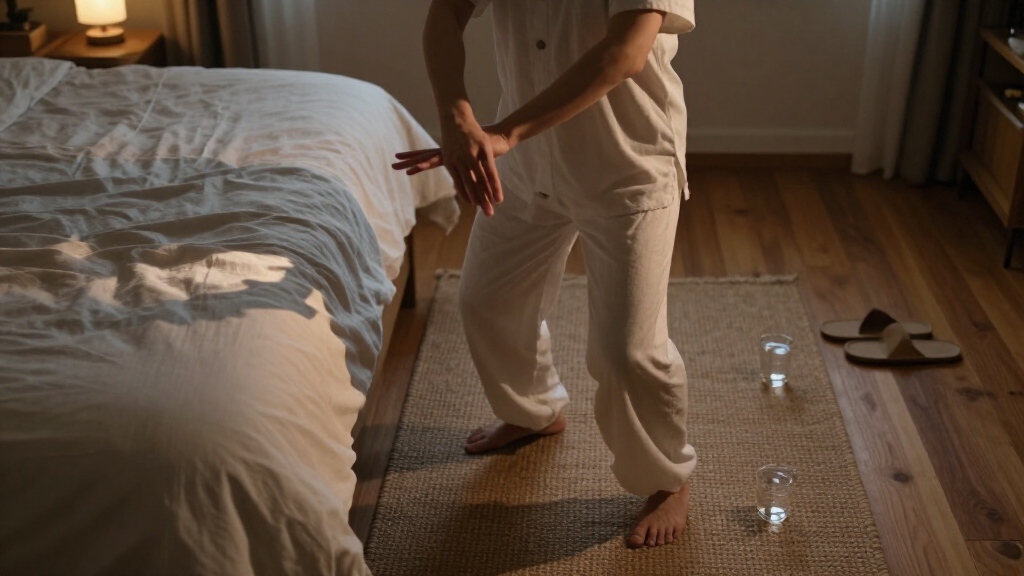
Next, the practice moves to standing. For “lift water,” participants raise relaxed arms to shoulder height while inhaling, then lower them gently. The longer silk-reeling sequence adds slow turns, arm circles and shifts in body weight, first using one hand and then both. The instructions call for slightly bent knees and movements coordinated with the breath.
The final part involves sitting or standing beside the bed to massage the neck, arms, torso and legs, followed by gentle patting with cupped hands. The source describes these as steps in a relaxation routine. It gives no clinical measurements, trial results or evidence that the particular movements produce a sleep benefit.
A Short Routine Before Bed
The routine offers readers a brief, structured option for winding down that does not require exercise equipment. Its steps are described as gentle and low-impact, and can be done in a small space with a chair available for the opening exercise. That may make the sequence practical for someone seeking a calm activity at the end of the day.
But the distinction between a suggested relaxation practice and a proven sleep treatment matters. Thompson’s explanation is an instructor’s account of why he recommends the practice; Fit&Well’s report does not provide a study testing this five-minute sequence. People should not interpret the recommendation as evidence that it will resolve persistent sleep problems or replace professional care.
Products Worth Considering

Withings Sleep Under-Mattress Sleep Tracking Pad

Therabody Theragun Mini 3rd Generation Massage Gun, Black

Therabody Theragun Relief Massage Gun
As an affiliate, we earn on qualifying purchases.
How the Sequence Is Structured
Tai Chi is a traditional Chinese practice involving gentle movement and focused breathing. Fit&Well describes Thompson as a Tai Chi teacher and founder of BNEW4LIFE. The report presents this sequence as his preferred way to close out the day, rather than as a newly tested intervention or formal clinical protocol.
The four parts move from stillness to motion and then back toward rest: seated breathing, arm lifts, silk-reeling movements, and massage with cupped-hand patting. The sequence can be shortened or approached slowly, but the source does not specify modifications for particular health conditions, mobility needs or injuries.
“The benefit of an evening Tai Chi practice is that it helps to unwind accumulated physical tension in the back, neck and shoulders from the day.”
— Brian Thompson, Tai Chi teacher and founder of BNEW4LIFE, as quoted by Fit&Well
Sleep Effects Are Not Established
The report does not identify a clinical study of Thompson’s specific five-minute routine, nor does it quantify changes in sleep onset, sleep duration or sleep quality. It is also unclear whether the routine has been tested in people with insomnia or other sleep disorders. The proposed effects on breathing, heart rate and the nervous system are attributed to Thompson, not independently verified in the source.
Individual responses may vary, and the instructions do not address whether every movement is suitable for every reader. Anyone with pain, balance concerns or a health condition may need to adapt movements or seek advice from a qualified professional. Ongoing sleep difficulties warrant discussion with a healthcare professional rather than reliance on a short exercise routine alone.
Trying the Practice Safely
The published instructions can be followed at a comfortable pace: begin seated, keep standing movements gentle, and stop if a movement causes pain or dizziness. Readers can treat the routine as an optional relaxation activity, while noting whether it feels comfortable for them; one evening’s experience cannot establish a reliable sleep effect.
Fit&Well’s report does not announce a follow-up study or further evidence. Any stronger conclusion about whether this sequence improves sleep would require research that tests the routine and reports its methods and outcomes. For now, Thompson’s recommendation remains a practical suggestion, not a confirmed treatment.
Key Questions
What are the steps in the five-minute Tai Chi practice?
It includes seated breathing, gentle standing arm raises, silk-reeling movements with weight shifts, and massage and cupped-hand patting. Fit&Well presents the sequence as a way to wind down in the evening.
Does the routine prove that Tai Chi improves sleep?
No. The source reports Brian Thompson’s recommendation and explanation, but does not cite research testing this particular five-minute sequence or establish that it improves sleep.
Can the practice be done seated?
The first breathing exercise is seated, while the later arm and silk-reeling movements are described standing. The report does not provide a full seated adaptation, so readers who need one may wish to consult a qualified Tai Chi instructor or healthcare professional.
What if sleep problems continue?
The routine should not be treated as a substitute for care. If sleep difficulties persist or affect daily life, speak with a qualified healthcare professional about appropriate next steps.
Source: rss