TL;DR

Get health and wellness essentials delivered free with Prime
- Fast, free delivery on millions of items
- Prime Video, Amazon Music and more included
- Member-only deals all year
Fit&Well published a five-minute barre arm routine designed by instructor Tara Riley, using continuous, controlled bodyweight movements and no equipment. Riley says the sequence can challenge arm endurance and shoulder control, though the source provides no research or measured results showing how much it improves either.
Fit&Well has published a five-minute barre arm workout created by instructor Tara Riley, a short, equipment-free routine intended to challenge arm muscular endurance and shoulder stability. The sequence uses five controlled movements, repeated in a specific order, and Riley recommends keeping the arms moving continuously through the routine.
The workout includes figure-of-eight arm movements, bend and press, small arm circles, pull and press, and a lateral arm wave. Participants stand with their feet hip-width apart for most movements and hold their arms around shoulder height. The routine combines slower repetitions, faster repetitions, and alternating arm patterns.
Its listed order is figure of eight, bend and press, small arm circles, pull and press, bend and press again, figure of eight, lateral arm wave, another bend and press, and a final figure of eight. The instructions specify repetition counts for each exercise, including eight slow and 16 faster figure-of-eight repetitions, and circles both forward and backward.
Riley says the routine is choreographed to Ed Sheeran’s song “Bad Habits” and is designed to flow from one exercise to the next. She describes it as a high-repetition, low-load session, rather than a substitute for lifting weights or a measured strength program. Fit&Well’s report does not provide testing, participant results, or evidence quantifying changes in endurance or shoulder stability.
A Short Session for Arm Endurance
The routine offers readers a brief workout that needs no equipment, with a clear sequence that can be done at home. Its emphasis is on sustaining movement and control, rather than adding external resistance. That may make it approachable for people seeking a short introduction to arm-focused exercise, while more experienced exercisers may use it as a lower-load endurance session, as Riley suggests.
Riley connects continuous arm movement with activities such as lifting, carrying, reaching, and holding the arms overhead. Those are her explanations of the workout’s potential relevance, not outcomes measured in the report. Readers should not treat the five-minute duration or the stated aims as a guarantee of improved performance.
The shoulder-stability focus also comes from Riley’s description of the movements. She says circles, figure eights, and pulling and pressing motions challenge the muscles that support shoulder movement in different directions. The article does not establish how the routine compares with other training or how often someone would need to do it for a particular result.
Products Worth Considering

BowFlex Results Series 552 SelectTech Adjustable Dumbbell

Bowflex SelectTech 840 Adjustable Kettlebell

Hyperice Hypervolt 3 Pro Percussion Massage Gun with Heated Head and Carry Case
As an affiliate, we earn on qualifying purchases.
How the Routine Is Structured
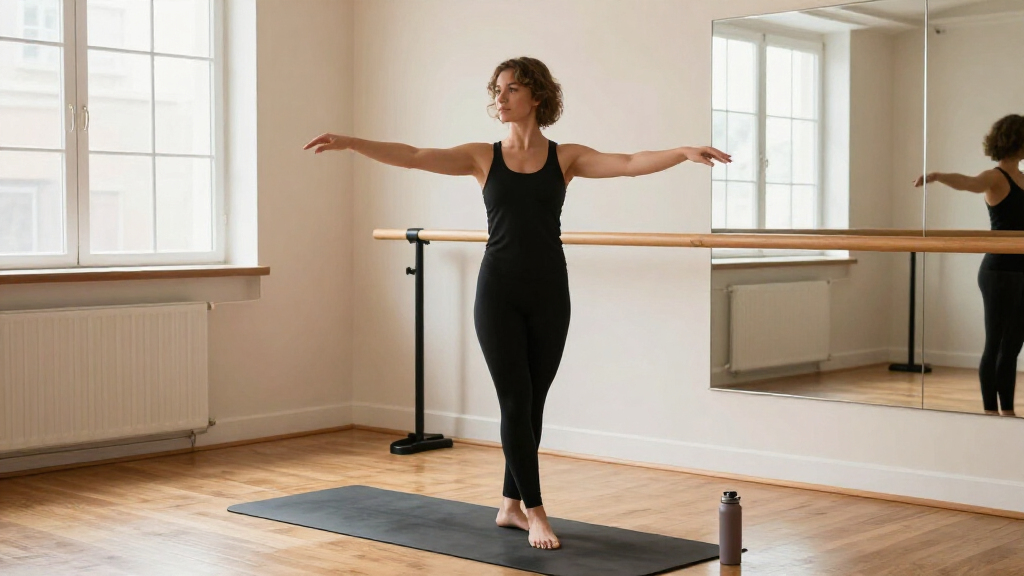
Barre draws on ballet-inspired positions and controlled movements. In this routine, the main working position is standing with the arms extended at shoulder height, with small changes in hand direction, elbow bend, and arm movement. The exercises are bodyweight movements; no dumbbells or other equipment are listed.
The five named exercises appear more than once in the sequence. Bend and press is repeated three times, while figure of eight appears three times. The instructions also include both single-arm and double-arm versions of some movements. Riley’s direction is to keep moving through the song rather than pausing between exercises, making the overall session a continuous sequence rather than separate sets with stated rest periods.
“I love lifting weights too, but never underestimate just how much you can challenge your muscles without holding a single thing.”
— Tara Riley, barre instructor, as quoted by Fit&Well
Results and Individual Suitability
The Fit&Well report does not cite a study or provide measurements showing that this specific routine improves muscular endurance or shoulder stability. It presents those as the workout’s aims and attributes its expected effects to Riley. It also does not state how often to repeat the routine, how to progress it, or whether the full sequence takes exactly five minutes for every person.
The source does not give adaptations for people with shoulder pain, limited mobility, or other health concerns. It also does not specify a warm-up, rest breaks, or a separate cool-down. A reader’s experience may vary with pace, movement control, and fitness level; the article does not report individual results.
Following the Published Sequence
Fit&Well’s report directs readers to learn the five movements, then complete them in the listed order while following the music. It does not announce a follow-up study, a new version of the workout, or a scheduled update. The next step for readers interested in trying it is to review the movement instructions and adjust the pace or stop if a movement causes discomfort.
Anyone with a health condition, injury, or questions about whether the exercises are suitable should consult a qualified health professional before making exercise decisions. The report offers a short routine, but does not provide individualized fitness or medical guidance.
Key Questions
What does the five-minute barre arm workout involve?
It uses five movements: figure of eight, bend and press, small arm circles, pull and press, and a lateral arm wave. Several movements recur in the sequence.
Does the routine require equipment?
No equipment is listed. Fit&Well describes it as an equipment-free bodyweight workout.
What benefits does the instructor say it targets?
Riley says the continuous, high-repetition movements are intended to work on arm and shoulder endurance and shoulder control. The report does not provide measured results or research specific to this routine.
What music is the workout choreographed to?
Riley says the sequence is choreographed to “Bad Habits” by Ed Sheeran.
How often should someone do the workout?
The report does not specify a recommended weekly frequency or progression plan. People with health concerns or questions about suitability should consult a qualified health professional.
Source: fitandwell.com